Published on: January 10, 2025
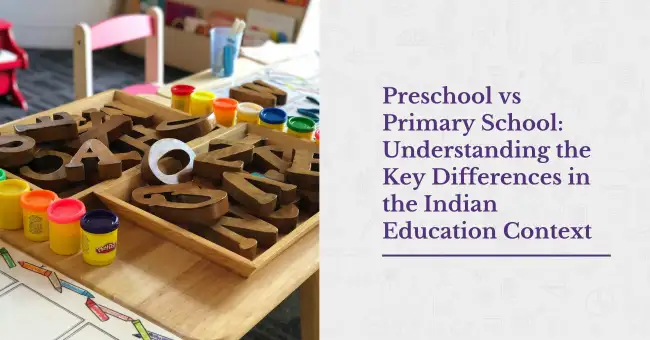
Preschool vs Primary School: Understanding the Key Differences in the Indian Education Context
In India, children's education starts with preschool and is followed by primary school—both stages lay a solid foundation for future learning. Here's an understanding of the key differences between preschool and primary school that can help parents, educators, and caregivers cater to different developmental needs and learning approaches.
Age Group and Learning Environment
Preschool in India caters to children aged 2.5 to 5, emphasising play-based learning to develop motor skills, language, and essential awareness through activities like storytelling, music, art, and group play. Primary school begins around age 6 and focuses on structured learning in subjects like Math, Science, Social Studies, and languages. A more formal approach emphasises group learning, critical thinking, foundational reading, writing, arithmetic, and problem-solving skills.
Curriculum Focus and Learning Approach
Preschools in India emphasise a child-centred, play-based curriculum to develop social, emotional, and cognitive skills. Through activities like storytelling, sensory play, and group routines, children explore basic concepts and build a love for learning in a safe, fun environment.
Primary school introduces a structured academic curriculum with subjects like Mathematics, Science, Social Studies, and languages, transitioning from concrete to abstract learning. Children begin memorising facts, following structured lessons, and developing logical thinking, often aligned with CBSE, ICSE, or state boards. Co-curricular activities continue but with a greater focus on academics.
Teaching Methodology
Preschools focus on experiential, play-based learning through sensory play, exploration, and creative activities like songs, rhymes, and art. Teachers act as facilitators to spark curiosity and build confidence.
Primary schools adopt a structured approach with textbooks, assessments, and formal lessons, emphasising academic achievement and test preparation. Students develop skills like note-taking, organising information, and independent study as part of their learning journey.
Social and Emotional Development
Preschool fosters social and emotional skills, helping children learn to share, cooperate, express feelings, and follow basic rules in a secure, nurturing environment.
In primary school, the focus shifts to navigating larger groups, managing responsibilities, collaborating on projects, and handling emotions tied to competition, exams, and grades. Teachers guide children in building resilience and forming broader peer relationships.
Parental Involvement
In preschools, parents play an active role through regular communication, participation in activities, and discussions on their child's development.
In primary school, parental involvement shifts to supporting independent learning, overseeing homework, fostering study habits, and attending parent-teacher meetings to track progress.
Assessment and Evaluation
Preschools focus on developmental milestones, using observation and play-based activities to track progress in communication, motor skills, and social behaviour.
Primary schools introduce formal assessments, including tests, quizzes, and assignments, to evaluate academic progress and ensure students meet benchmarks in core subjects.
Written by:
JBCN International School, Oshiwara
FAQs
-
What’s the biggest difference between preschool vs primary school learning?
In the preschool vs primary school debate, preschool emphasizes play-based learning, while primary school introduces structure and academics. Understanding preschool vs primary school differences helps set expectations.
-
How does a child’s development shift from preschool vs primary school?
In preschool vs primary school stages, children go from sensory exploration to logical thinking. Emotional and cognitive development accelerates in the preschool vs primary school transition.
-
How should parents prepare kids for preschool vs primary school transitions?
Routine, communication, and confidence-building help kids shift from preschool vs primary school smoothly. Preparation is crucial in easing anxiety around the preschool vs primary school leap.
-
Why do expectations differ in preschool vs primary school systems?
Preschool vs primary school systems cater to unique cognitive levels. Preschool nurtures foundational behavior, while primary education builds on it—making preschool vs primary school roles clearly defined.
Share