
Published on: November 6, 2026
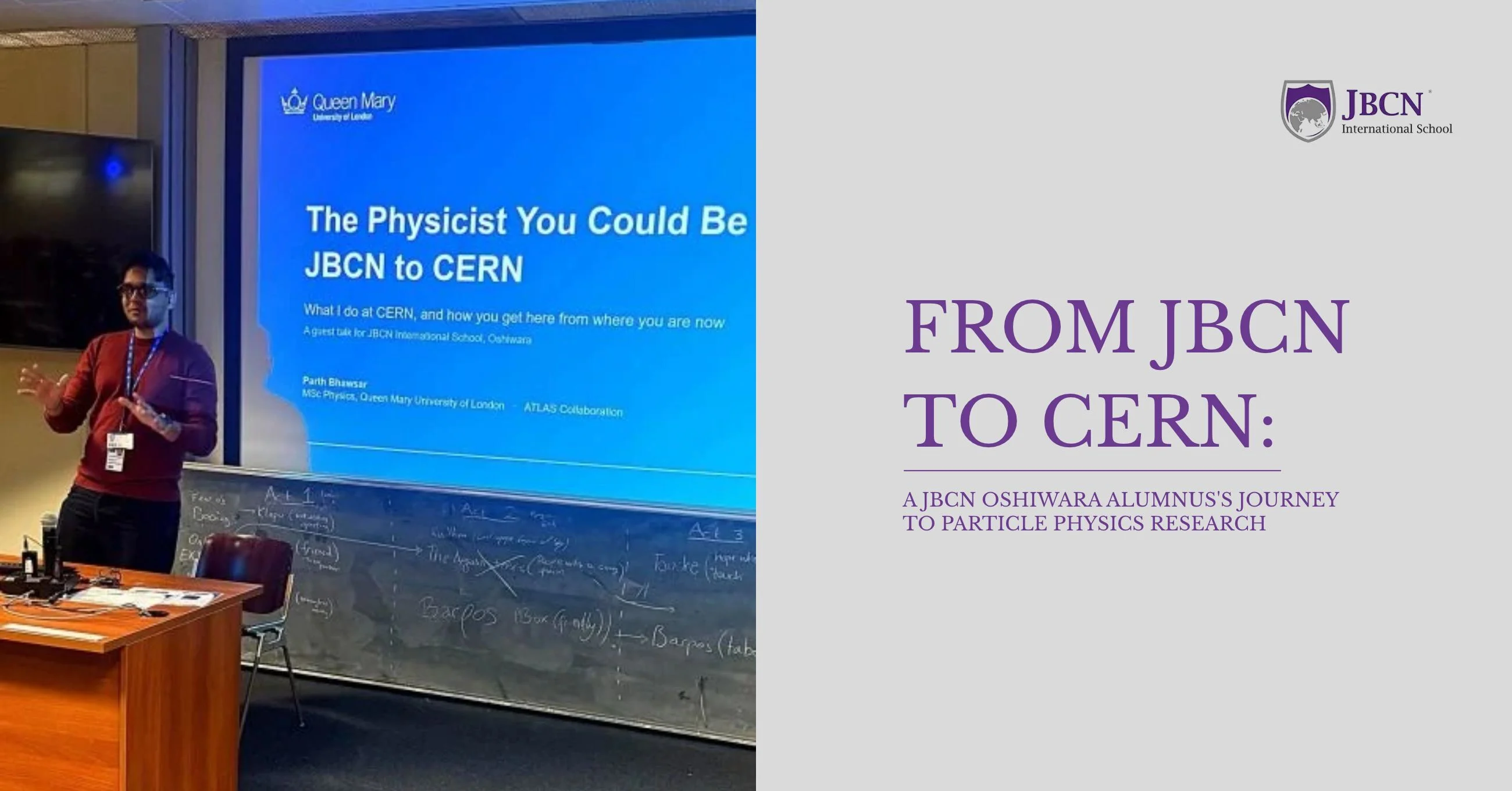
"JBCN to CERN" is the journey of Parth S. Bhawsar, from JBCN International School, Oshiwara (Batch of 2022) with a love of physics and a dream of one day working at CERN, the European Organization for Nuclear Research near Geneva. Today he is studying for an MSc in Physics with AI and Machine Learning at Queen Mary University of London and is doing an internship at CERN. This week he stood at the front of a room at CERN and spoke to a group of JBCN learners, with "JBCN to CERN" on his title slide.
From JBCN to CERN at a Glance
|
Stage |
What We Know |
|
2022 |
Leaves JBCN International School, Oshiwara with a love of physics and a dream of CERN |
|
University |
MSc in Physics with AI and Machine Learning, Queen Mary University of London |
|
Now |
Internship at CERN, building a transformer model to search for a rare Higgs boson decay |
|
Recently |
Speaks to JBCN learners at CERN, under the title "JBCN to CERN" |
The Journey: From a JBCN Classroom to CERN
CERN was the place Parth dreamed about, over and over, never quite sure he would get there. He left JBCN Oshiwara in 2022 with that dream, a love of physics, and the habits he now tells younger learners to build: take maths seriously, learn to code early, and apply for things that feel too big.
When JBCN learners walked into CERN this week, he was at the front of the room. "Not long ago, I was sitting exactly where they were," he said. The journey from a JBCN classroom to CERN took him through university-level physics, machine learning and a research project at one of the world's largest particle physics laboratories.
What Parth Works on at CERN
CERN is a particle physics laboratory founded in 1954. It runs the Large Hadron Collider (LHC), a 27 km ring about 100 metres underground, where the ATLAS and CMS experiments announced the discovery of the Higgs boson in 2012. Parth works where physics meets artificial intelligence:
- The rare decay: only about 2 in every 10,000 Higgs bosons decay to two muons, so the signal is a needle in a haystack of similar events
- The method: he is building a transformer model, the same family of architecture behind ChatGPT, to find these events among millions of collisions
- The status of the science: the ATLAS experiment reported evidence for this decay in 2025, and CMS reported evidence earlier. More data is needed before it can be called a discovery
He was open with the learners about the hard parts. His model performed well, then did something he did not expect. Working out why taught him more about machine learning than any lecture: a good score means nothing until you understand what the model is actually looking at.
The Foundations Behind the Journey
No school can promise a place at CERN. What a school can do is build the foundations that make a journey like Parth's possible. Each piece of his advice connects to subjects and experiences JBCN learners can take up in the senior years.
|
What Parth Says Matters |
How JBCN Builds It |
|
Take maths seriously |
Mathematics and Further Mathematics in Cambridge A Levels (Borivali and Oshiwara), and Mathematics in the IB Diploma (Parel, Oshiwara and Chembur) |
|
Learn to code early |
Computer Science in Cambridge A Levels (Borivali and Oshiwara) and the innovation strand of the iPROPEL programme |
|
Love physics |
Physics in the IB Diploma and Cambridge A Levels, taught by a faculty of whom nearly 50% are official IB and Cambridge examiners and curriculum consultants |
|
Apply for things that feel too big |
The research and leadership strands of iPROPEL, and the independent research of the IB Extended Essay |
|
Keep going when you are wrong |
Inquiry-led learning through the EduCreative approach, which pairs academic depth with learning beyond the classroom |
How JBCN Prepares Learners for Science and Research Careers
Parth's old campus and the wider JBCN group offer a strong platform for learners who want to study science and go on to research:
- Top 30 IB results: JBCN Parel and Oshiwara each average 39.0 points against a global IB average of 30.9, placing JBCN among the Top 30 IB Schools in the World (IB-Schools.com 2026, provisional results), with a 100% IBDP pass rate
- Examiner-led teaching: Nearly 50% of JBCN educators are official IB and Cambridge examiners and curriculum consultants
- Two senior pathways at one campus: JBCN Oshiwara is the only JBCN campus that offers both the IB Diploma and Cambridge A Levels
- Recognition for Oshiwara: JBCN Oshiwara is ranked No. 1 in the IB, Cambridge and International Curriculum zonal rankings (Mid-Day School Survey 2026)
- Early university guidance: university counselling begins in Grade 7, so subject choices are planned against course requirements years before Grade 11
- University outcomes: JBCN's Class of 2026 received 488 university offers across 19+ countries, with USD 6 million in scholarships
What Parth Told JBCN Learners at CERN
He told the learners what the work really looks like, not the polished version. His advice was simple:
- Take maths seriously.
- Learn to code early.
- Apply for things that feel too big for you.
- Keep going when you are wrong, because you will be, often.
He closed with what he wished someone had told him at 16: nobody at CERN knows exactly what they are doing either. They are just wrong more carefully than they were last year. He said the learners' questions were brilliant, and that their curiosity reminded him why he started.
A Pathway Other Learners Can Follow
Parth's journey is one learner's path, but its steps are open to many:
- Build strong foundations in maths and physics in the senior years, through the IB Diploma or Cambridge A Levels.
- Learn to code early, and apply it to real problems.
- Seek out research exposure. CERN runs programmes for school students and teachers, including the Beamline for Schools competition for teams of high-school students aged 16 or older. Check CERN's website for current eligibility.
- Choose a university course that combines physics with computing, mathematics or data science.
- Keep applying for opportunities that feel too big, and keep learning from the results.
Explore Physics, Maths and Computer Science at JBCN
Speak with our admissions team or visit JBCN Oshiwara. You can also read about the IB Diploma Programme at JBCN.
Frequently Asked Questions
-
How Did a JBCN Learner End Up at CERN?
Parth S. Bhawsar left JBCN International School, Oshiwara in 2022 with a love of physics and a dream of working at CERN. He went on to study physics at university, is now studying for an MSc in Physics with AI and Machine Learning at Queen Mary University of London, and is doing an internship at CERN.
-
Can a JBCN Education Lead to a Career at CERN?
No school can guarantee a career at CERN, which depends on university study, research experience and persistence. Parth's journey shows what a strong foundation in maths, physics and coding, plus curiosity and willingness to apply for ambitious opportunities, can lead to. JBCN offers those foundations through the IB Diploma and Cambridge A Levels.
-
Who Is Parth S. Bhawsar?
Parth S. Bhawsar is a JBCN Oshiwara alumnus who left the school in 2022. He is studying for an MSc in Physics with AI and Machine Learning at Queen Mary University of London and is currently doing an internship at CERN.
-
What Did JBCN Learners Do at CERN?
JBCN learners visited CERN and heard a session led by Parth S. Bhawsar on working where physics meets AI, searching for a rare Higgs boson decay, and building a path into research.
-
What Is the Higgs Boson Decaying to Two Muons?
It is a very rare way for a Higgs boson to decay, into a muon and an antimuon, which happens in only about 2 in 10,000 Higgs bosons. Many other processes mimic it, so physicists use advanced analysis and machine learning to find it. The ATLAS and CMS experiments have reported evidence for it, and more data is needed to confirm a discovery.
-
Which Subjects Help for a Career in Particle Physics and AI?
Mathematics, Physics and Computer Science form the core of this path, and Parth's own advice is to take maths seriously and learn to code early. JBCN learners can study these in the IB Diploma and in Cambridge A Levels.
Share