
Published on: June 11, 2026
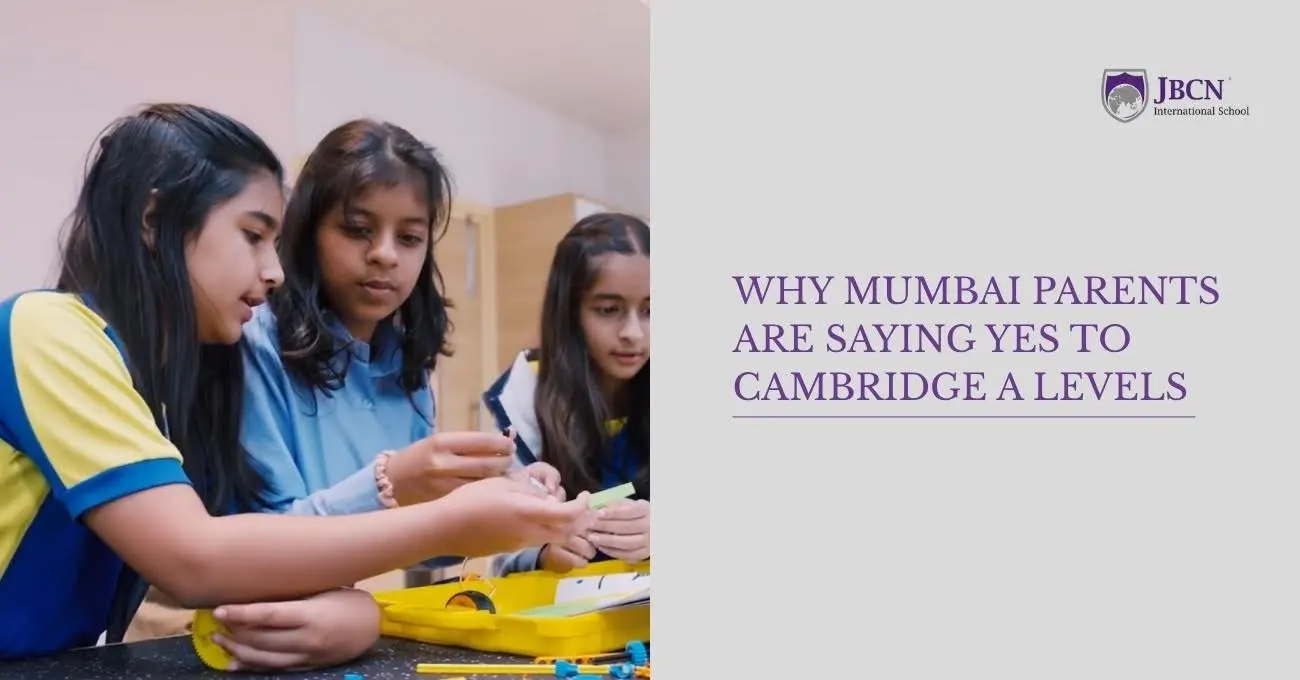
The way Mumbai parents talk about school has shifted. The question used to be which board is closest to home or most familiar. Now it is about exposure, confidence, and whether a child can adapt anywhere in the world. For a growing number of families, that conversation is leading to Cambridge A Levels.
What Are Cambridge A Levels?
Cambridge A Levels are subject-based qualifications studied in Grades 11 and 12, usually after the International General Certificate of Secondary Education (IGCSE). Most Learners take three or four subjects in real depth, beginning with the Advanced Subsidiary (AS) year and completing the full Cambridge International AS and A Levels in the second year.
Rather than covering many subjects at a surface level, A Levels go deep into a chosen few. The qualification is recognised by universities across the world, which is a large part of its appeal.
How Cambridge A Levels Differ From Other Curriculum
What sets A Levels apart is less the content and more the approach. Compared with a more traditional, recall-heavy board, the emphasis moves from how much a Learner can memorise to how well they can think and apply what they know.
A few differences stand out:
- Fewer subjects, studied in real depth, rather than many covered quickly.
- Free subject combinations, rather than fixed Science, Commerce, or Arts streams.
- Marks earned for analysis, problem-solving, and argument, rather than recall alone.
- Assessment spread across written papers and, in some subjects, practicals or coursework.
Is Cambridge A Levels the Right Fit for Your Child?
A Levels work particularly well for Learners who already have a sense of the subjects they enjoy and may want to pursue at university. Because the programme allows students to focus on three or four subjects in depth, it suits those who prefer specialisation over studying a broad range of disciplines.
A Levels may be a strong fit for Learners who:
-
Have clear interests in areas such as engineering, medicine, business, economics, humanities, or the sciences.
-
Enjoy exploring subjects in greater depth rather than dividing their attention across many areas.
-
Prefer analytical, subject-focused learning.
-
Are you considering university applications in India or overseas?
-
Want flexibility to combine subjects around their strengths and aspirations.
For Learners who enjoy a broader academic experience across six subjects, the IB Diploma Programme may also be worth exploring. The right choice depends on a child's learning style, interests, and future goals.
Why Mumbai Parents Are Choosing A Levels
Beyond the classroom approach, several practical benefits draw Mumbai families to Cambridge A Levels. Most come back to keeping a child's options open while helping them grow into a confident young adult.
Global Recognition
A Levels are accepted by leading universities across the United Kingdom, the United States, Canada, and Australia. For families who may want their child to study abroad, that recognition keeps the path clear. Admissions teams already know the qualifications, so applying overseas stays straightforward.
Local Acceptance
The qualification is recognised in India through the Association of Indian Universities (AIU) as equivalent to Class 12. Moving into Indian higher education is therefore just as smooth as applying overseas. With the right subjects, a Learner can also sit national entrance exams later on.
Conceptual Depth
Learners are assessed on how well they analyse data, solve real problems, and build a logical argument, not on memory alone. Lessons reward understanding over recall, so a child learns to reason rather than repeat. Parents often notice their child explaining ideas more clearly than before.
Subject Flexibility
Learners can pair analytical subjects like Mathematics or Physics with the arts or humanities, rather than being locked into a fixed stream. That freedom lets a child shape a combination around real interests and career goals. Engagement tends to follow, since the subjects feel chosen rather than imposed.
A Levels vs IB: Understanding the Difference
Both Cambridge A Levels and the International Baccalaureate Diploma Programme are internationally recognised pathways that prepare Learners for university. The key difference lies in breadth and depth.
A Levels allow Learners to specialise early by focusing on three or four subjects in significant depth. The IB Diploma takes a broader approach, requiring students to study six subjects alongside core components such as Theory of Knowledge, the Extended Essay, and Creativity, Activity, Service.
Neither pathway is inherently better than the other. A Levels often appeal to students with clear academic interests who want to specialise, while the IB may suit Learners who enjoy maintaining strength across a wider range of subjects.
The best choice depends on a Learner's interests, strengths, and future university plans.
A Levels for Indian Learners
A Levels are not only a route abroad. Indian families, they keep both local and international doors open at the same time.
Within India, A Levels are recognised by the AIU as equivalent to Class 12, so a Learner can apply to Indian universities. With the right subjects, A Level Learners can also sit national entrance exams: the Joint Entrance Examination (JEE) for engineering needs Physics, Chemistry, and Mathematics, while the National Eligibility cum Entrance Test (NEET) for medicine needs Physics, Chemistry, and Biology, each alongside an AIU equivalence certificate.
Abroad, A Levels are accepted by universities across the United Kingdom, the United States, Canada, Australia, and beyond.
For families still comparing routes, how the main boards line up is a useful starting point.
Cambridge A Levels at a Glance
A quick summary of what A Levels offer Mumbai families is set out below.
| Feature | What It Means for a Learner |
|---|---|
| Subject choice | Mix subjects freely rather than fixed streams |
| Depth | Fewer subjects, studied in greater depth |
| Assessment | Written exams, with practicals or coursework in some subjects |
| Recognition | Accepted by Indian universities through the AIU, and worldwide |
| University readiness | Research, writing, and independent study are built in |
How to Prepare Your Child for A Levels
Preparing for A Levels is less about studying ahead and more about building the right habits early. A Learner who is comfortable reading widely, managing time, and thinking independently steps into the two years with real confidence. None of this needs to be rushed, as small and steady steps work best.
A few things help in the run-up:
- Encourage wide reading and curiosity, so asking questions feels natural rather than forced.
- Build simple study routines and time management before the workload grows.
- Talk through subject choices early, linking them to interests and possible university paths.
- Lean on the school's counsellor for guidance on combinations and entry requirements.
- Let your child take ownership of small projects, which strengthens independent work.
A Levels at JBCN
At JBCN International School, Cambridge A Levels are offered at the Borivali, Parel, and Oshiwara campuses. Learners receive guidance on subject selection, university pathways, and long-term career planning through the school's dedicated Careers and University Guidance team.
The flexibility of the A Level pathway is supported by personalised mentoring, helping Learners choose subject combinations that align with both their strengths and university aspirations. For students considering competitive pathways in India or overseas, this guidance helps ensure that subject choices support future opportunities from the outset.
Learners stepping into the senior years can also apply for the merit-based Rakesh Jhunjhunwala, Pinky Dalal Scholarship, which supports strong candidates entering A Levels.
Begin the Conversation
Choosing a senior pathway is a big step, and it helps to talk it through with people who guide these decisions every year. A short conversation can match a Learner's strengths to the right subjects and the right campus.
Speak with our admissions team or visit a campus to see the Cambridge A Levels pathway at JBCN.
Frequently Asked Questions
-
Q. What are Cambridge A Levels?
Cambridge A Levels are subject-based qualifications for Grades 11 and 12, usually taken after IGCSE. A Learner studies three or four subjects in depth, and the qualification is recognised by universities in India and around the world.
-
Q. Why are Mumbai parents choosing A Levels?
Many choose A Levels for the emphasis on understanding over memorisation, the freedom to mix subjects, and strong preparation for university. The global recognition of the qualification is also a major draw.
-
Q. Are A Levels recognised in India?
Yes. The Association of Indian Universities recognises Cambridge A Levels as equivalent to Class 12, so Learners can apply to Indian universities with an AIU equivalence certificate.
-
Q. Can A Level Learners sit JEE and NEET?
Yes. A Level Learners can appear for JEE and NEET if they have studied the required subjects, Physics, Chemistry, and Mathematics for JEE, and Physics, Chemistry, and Biology for NEET, and hold AIU equivalence.
-
Q. Which is better for university admissions: A Levels or IB?
Universities around the world recognise and value both qualifications. A Levels allow students to specialise in a smaller number of subjects, while the IB Diploma offers a broader academic experience. The better choice depends on a Learner's strengths, interests, and intended university pathway.
-
Q. How many subjects do you take at A Level?
Most Learners take three or four subjects, beginning with the Advanced Subsidiary year and completing the full A Level in the second year. Fewer subjects allow a deeper study of each one.
-
Q. Are A Levels good for studying abroad?
Yes. A-levels are accepted by universities across the United Kingdom, the United States, Canada, Australia, and many other countries, which makes international applications smoother.
Share