
Published on: September 23, 2026
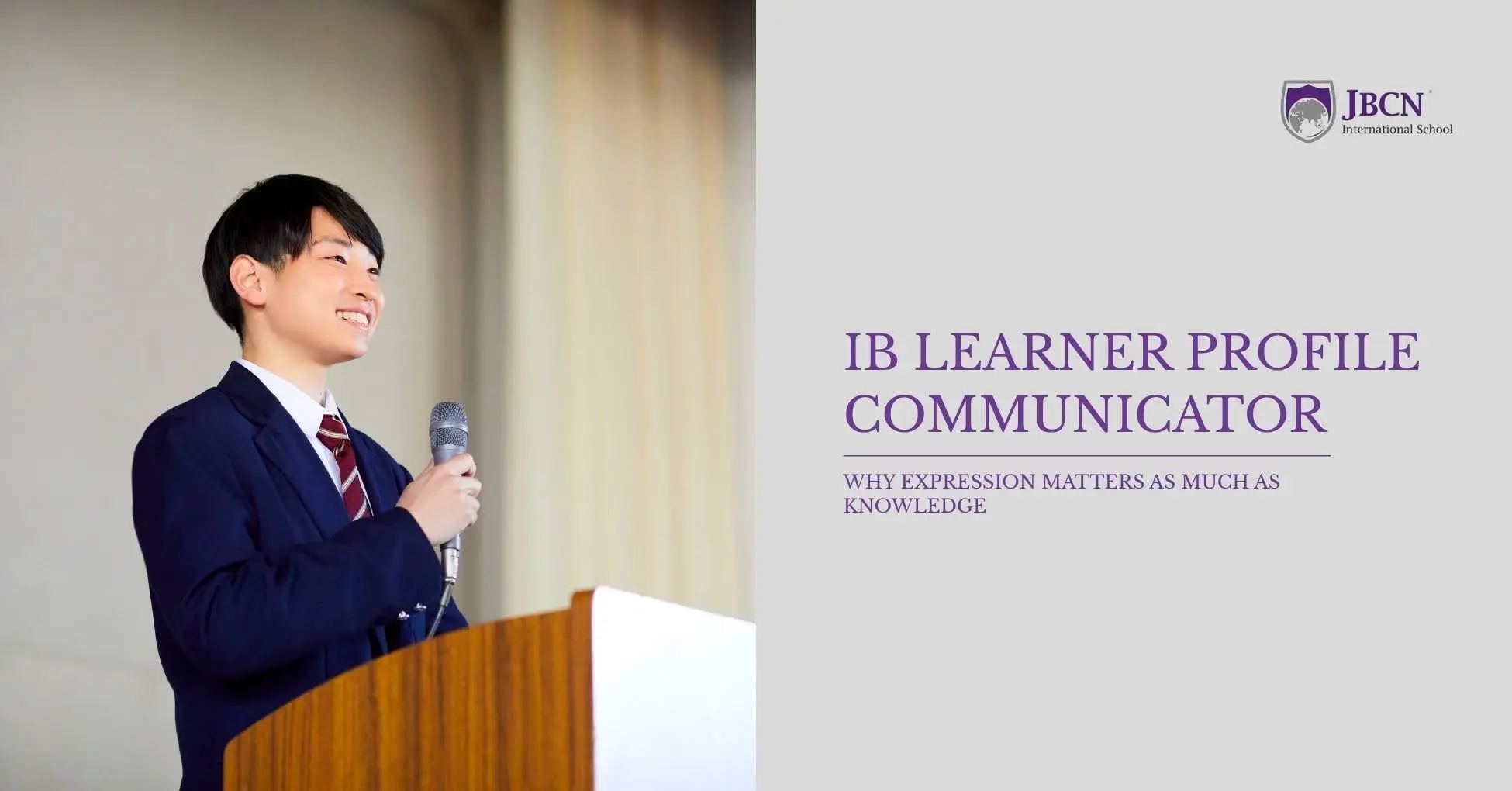
Every parent of a young child knows the moment their child finally manages to explain something- an idea, a feeling, a problem- in a way that lands. That capacity to express clearly is not just a social skill. It is one of the most transferable abilities a child will ever develop, and one that universities, employers, and the world consistently reward. The Communicator attribute of the IB Learner Profile puts this development at the centre of education, from the earliest years through to the IB Diploma.
All Ten IB Learner Profile Attributes
The Communicator attribute is one of ten interconnected qualities the IB develops in every learner. The Communicator row is highlighted.
|
Attribute |
What It Means |
|
Inquirer |
Nurtures curiosity and a love of learning; develops skills to investigate independently and collaboratively |
|
Knowledgeable |
Develops conceptual understanding across a range of subjects and disciplines |
|
Thinker |
Applies critical and creative thinking skills to analyse and act on complex problems |
|
Communicator |
Expresses ideas confidently and creatively in more than one language and mode; listens actively to others |
|
Principled |
Acts with honesty and integrity; takes responsibility for actions and their consequences |
|
Open-minded |
Appreciates own culture while respecting perspectives of others |
|
Caring |
Shows empathy, compassion, and respect; commits to service and making a difference |
|
Risk-taker |
Approaches uncertainty with forethought and determination; works creatively and independently |
|
Balanced |
Understands the importance of intellectual, physical, and emotional balance |
|
Reflective |
Thoughtfully considers learning and experience to improve understanding and growth |
What the IB Learner Profile Communicator Attribute Means
The IB defines a Communicator as a learner who "expresses themselves confidently and creatively in more than one language and in more than one way. They collaborate effectively, listening carefully to the perspectives of other individuals and groups."
Three things stand out in that definition. First, communication is explicitly bilateral — listening is as important as speaking. Second, it encompasses more than one mode: written, spoken, visual, and creative expression all count. Third, multilingualism is built into the attribute from the start.
In practical terms, a Communicator is a child who can explain what they know in more than one way, who adjusts their language and approach to their audience, who listens to understand rather than just to respond, and who expresses ideas in writing, speech, and creative forms with growing confidence.
How Communication Skills Build Across the IB Continuum
Communication is not a single skill taught in one lesson. It is a capacity built in layers across every stage of the IB, with each year adding depth, structure, and expectation.
In the Early Years — IB PYP
Young learners begin with storytelling, show-and-tell, collaborative play, and early language exploration. The focus at this stage is comfort and confidence: a child who feels safe to speak, who learns that their voice is worth hearing, is building the emotional foundation that all future communication rests on. Early multilingual exposure, through language acquisition built into the IB curriculum, begins the habit of reaching across languages.
Through the Middle Years
As learners grow, communication becomes more structured. Presentations, group projects, formal discussions, and written tasks ask them to organise their thinking before expressing it. Listening and turn-taking shift from social expectations to explicit skills. A learner who can chair a group discussion, synthesise what others have said, and build on it without dominating it is demonstrating the Communicator attribute in action.
In the IB Diploma
At Diploma level, communication is formally assessed in almost every component. Theory of Knowledge asks learners to present and defend ideas, adapt to questions, and demonstrate oral clarity under pressure. The Extended Essay demands 4,000 words of sustained, structured, original written argument. Internal Assessments across subjects test written and oral communication in Science, Humanities, Languages, and the Arts. By the time a JBCN Learner sits their final IBDP examinations, they have practised high-stakes communication in almost every format imaginable.
What Communication Skills Do for University Applications
The connection between the Communicator attribute and university outcomes is direct. The personal statement (UCAS), the Common App essays (US universities), and university interviews are all pure communication challenges. A learner who has spent six years in a programme that explicitly develops written argument, oral clarity, and multilingual awareness arrives at these moments with habits that most applicants build — if at all — in the final months before applying.
Research: HESA data (2013-19, matched samples) shows IB Diploma graduates are significantly more likely to achieve first-class honours degrees at UK universities than comparable peers. Clear academic writing and articulate oral communication both products of the Communicator attribute, are exactly what university assessors reward.
Where Learners Practise Communication Beyond the Classroom
The strongest communication growth often happens in contexts where the stakes are real, and the audience is genuine. Co-curricular activities give learners repeated, varied practice in exactly this.
- Model United Nations (MUN): delegates research a country's position, write a formal position paper, speak in committee, negotiate across disagreement, and defend their stance under questioning. JBCN learners have won awards at MUN conferences, including the Indira Gandhi Best Female Parliamentarian Award at Sansad Youth Parliament 2025 and Outstanding Delegate honours at external conferences across Mumbai
- Public speaking and debate: structured speaking programmes build composure, vocabulary, and the ability to think clearly under pressure, skills that carry into interviews, presentations, and everyday professional life
- Performing arts: theatre, music, and dance develop physical expression, creative communication, and the confidence of performing to an audience, all of which expand what a Learner understands communication to be
- iPROPEL: JBCN's structured co-curricular framework (Innovation, Performing Arts, Research and Reasoning, Outreach, Physical Fitness, Experiential Learning, and Leadership) makes these activities mandatory and intentional rather than optional and occasional
How Parents Can Nurture the Communicator Trait at Home
Communication grows fastest where a child feels genuinely heard, and the home is where that feeling is most reliably built. Small, regular habits do more than occasional big efforts.
- Create space for dinner-table discussion: ask everyone at the table for one thing they noticed, heard, or found interesting that day — and listen without correcting or evaluating. The habit of being heard encourages the habit of speaking
- Practise active listening together: ask your child to summarise what they heard someone else say before responding. This single habit builds the listening dimension of communication that is often overlooked
- Read together and discuss ideas, not just plot: 'what do you think the character should have done?' and 'do you agree with that?' build the kind of responsive, evaluative communication that IB assessments reward
- Let your child explain things to you: ask them to teach you something from school. The act of explaining to a real audience, not writing an answer in a book, sharpens clarity and reveals gaps in understanding
- Encourage multilingual expression: if your family has a language other than English at home, use it. Switching between languages builds cognitive flexibility and the multilingual dimension of the Communicator attribute directly
- Celebrate the attempt, not just the result: a child who tries to express a complex idea and does not quite manage it has still practised something valuable. Praising the attempt creates the safety that communication confidence needs
How JBCN Develops the Communicator Attribute
At JBCN International School, communication is developed explicitly and deliberately across all five Mumbai campuses, from pre-primary through to the IB Diploma at Parel, Oshiwara, and Chembur.
- EduCreative philosophy: JBCN's teaching approach builds every lesson around discussion, collaborative exploration, and expressive output rather than passive absorption. Communication is practised in the fabric of the school day, not added on as an extra
- IB PYP from Pre-Nursery: the transdisciplinary units of inquiry require young learners to share findings, explain thinking, and present understanding, building oral and written communication from the first year of school at all three IB campuses
- TOK and Extended Essay: both core IBDP components are fundamentally communication tasks, one oral and analytical, one written and sustained, assessed by IB examiners, many of whom teach at JBCN
- MUN and performing arts through iPROPEL: structured co-curricular participation gives every learner multiple formats of real-audience communication practice across the school year
- Language acquisition: the IB's language requirements are embedded in every stage of the continuum, building the multilingual dimension of the Communicator attribute systematically
JBCN results: 100% IBDP pass rate across multiple years. School average of 37.7 points against a global average of 30.9. All JBCN IBDP learners received admission to the university of their choice, universities that assessed personal statements, essays, and interviews before making their offers.
Take the Next Step
The clearest way to see communication taught with intention is to watch a classroom, a debate, or a MUN committee in action. Come and see how JBCN builds confident, multilingual, and creative communicators from the earliest years.
Speak with our admissions team or visit a campus at Parel, Oshiwara, or Chembur.
Frequently Asked Questions
-
What does Communicator mean in the IB Learner Profile?
A Communicator expresses ideas confidently and creatively in more than one language and mode, while listening carefully to the perspectives of others. The attribute covers written, spoken, visual, and creative expression, and treats listening as equally important to speaking. It is one of the ten IB Learner Profile attributes developed across PYP, MYP, and IBDP.
-
What is the language requirement in the IB?
The IB builds language learning into every stage of the continuum. In the IB PYP, language acquisition is part of the transdisciplinary curriculum. In the IBDP, learners study at least two languages, one as their primary language of instruction and one as a second or additional language. The goal is communicative growth rather than native fluency, and the multilingual dimension is embedded rather than optional.
-
How does TOK build communication skills?
Theory of Knowledge asks learners to construct arguments about how knowledge is built and tested, then present and defend those arguments, both in a written essay and in an oral exhibition. The process sharpens written clarity, oral fluency, and the ability to listen and adapt under questioning. TOK is one of the most direct and formally assessed communication builders in the IB Diploma.
-
Does MUN count as communication practice for university applications?
Yes, and it is one of the most useful kinds. MUN gives learners specific, evidenced examples of formal communication under pressure, position papers, formal speeches, negotiation, and rebuttal that they can write about in personal statements and speak to in interviews. JBCN learners have won awards at MUN conferences, including the Indira Gandhi Best Female Parliamentarian Award at Sansad Youth Parliament 2025, providing exactly the kind of concrete achievement that university admissions teams look for.
-
How is the Communicator different from the Thinker?
Thinker is about analysing information and solving problems; Communicator is about expressing and sharing ideas clearly with others. The two attributes are closely linked; a good idea still needs to be articulated well to have impact, but they develop distinct skills. Thinker is internal; Communicator is relational.
-
Why is communication important in the IB Diploma?
Almost every component of the IB Diploma is assessed partly on how clearly ideas are expressed. The Extended Essay tests sustained written argument. TOK tests oral presentation and written reasoning. Internal Assessments across subjects test written and oral communication in their respective disciplines. Beyond the programme, university personal statements, interviews, and degree-level writing all demand communication skills that the Diploma develops directly.
-
How can parents support the Communicator attribute at home?
Create dinner-table discussions where every view gets heard. Practise active listening by asking your child to summarise what someone else said before responding. Read together and discuss ideas rather than just plot. Let your child explain school topics to you; teaching to a real audience sharpens clarity. Encourage multilingual expression if your family has another language at home. Celebrate the attempt to communicate a complex idea, not just the success.
-
At what age does the Communicator attribute start developing?
From the very first year of school. At JBCN's IB PYP campuses, Pre-Nursery learners begin building oral expression, listening, and early language awareness from nursery. The IB treats communication as a skill developed steadily across every stage, not introduced at secondary school.
Share