
Published on: June 22, 2026
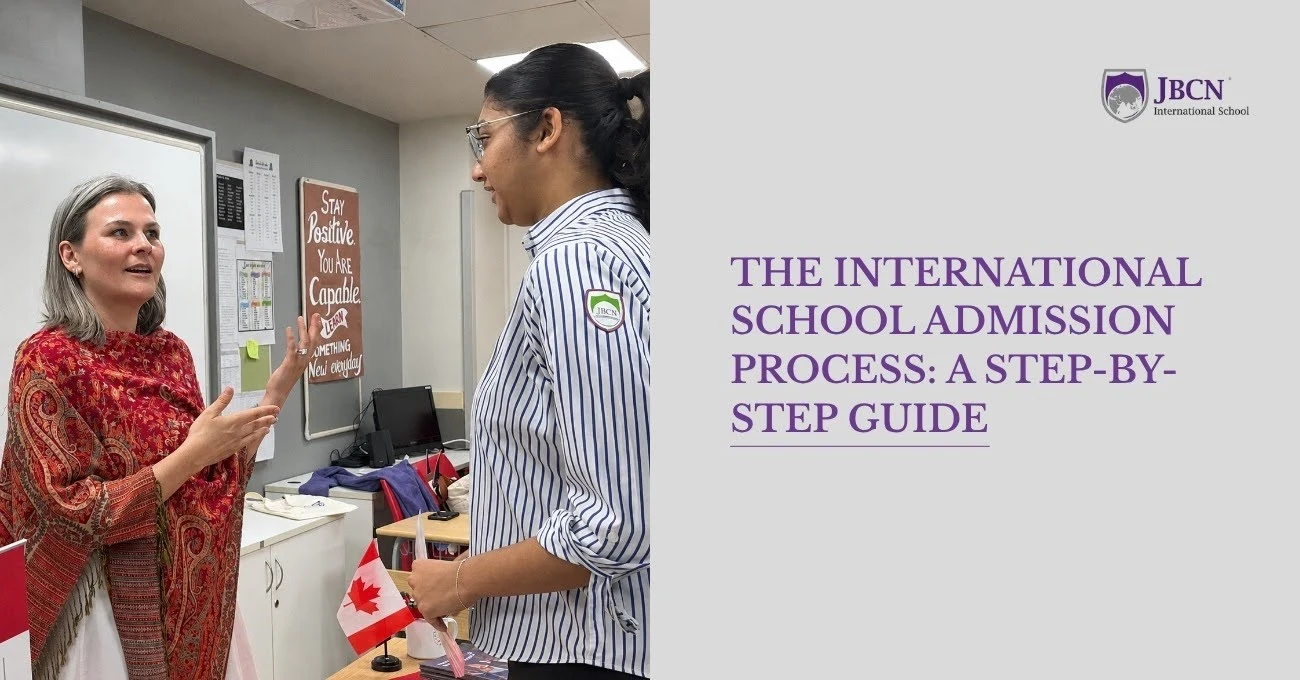
Few things feel as daunting to a parent as starting the school admission process, when each school seems to have its own forms, dates, and requirements. The good news is that most international schools follow a similar path, and once you see the whole route, it stops feeling overwhelming. Here is the international school admission process step by step, the documents you need, and when to start.
What Does the International School Admission Process Involve?
The international school admission process is a sequence of clear stages, from first enquiry to a confirmed seat. Most schools follow the same path, even if the step names differ slightly.
A typical admission runs through six steps:
- Research and shortlist schools by curriculum, location, and fit.
- Register and complete the application form.
- Submit the required documents.
- Complete an age-appropriate assessment or interaction.
- Attend the parent and child interview.
- Accept the offer and confirm the seat.
Each step is simpler than it sounds, and the sections below cover all six.
The Admission Process, Step by Step
Knowing what each stage asks of you removes most of the worry. The process moves in order, so a calm, early start on step one makes the rest fall into place.
Step 1: Research and Shortlist Schools
Shortlisting comes first, and it is worth the time. Families usually compare curricula such as the IB, Cambridge, and ICSE, alongside distance, class sizes, and the feel of each campus. A look at how the main boards compare makes that first choice clearer, and a campus tour tells you more than a brochure.
Step 2: Register and Apply
Most international schools use an online portal. A parent creates a profile, completes the application form, and submits it to enter the applicant pool. A registration or application fee may apply, which the school confirms.
Step 3: Submit the Required Documents
Step three is gathering and uploading the required documents, usually as scanned copies. The full checklist sits in the next section, though the birth certificate, recent report cards, and photographs are the essentials.
Step 4: The Assessment or Interaction
Schools then meet the child to understand their level and readiness. For the early years, this is a gentle, play-based observation of communication and settling in. For older grades, it is usually a short, age-appropriate assessment in English, mathematics, and reasoning to place the child in the right grade.
Step 5: The Parent and Child Interview
Many schools include a friendly interview with the child and the parents. The aim is to fit, a chance to talk through values and expectations. Held in person or online, it is a conversation rather than a test, so honesty matters more than impressing.
Step 6: The Offer and Enrolment
If the application is successful, the school issues an offer of admission. To secure the seat, a family reviews the fee structure and completes the joining formalities and fees to confirm enrolment.
Documents Required for International School Admission
Most international schools ask for a similar set of documents, and having them ready early prevents delays. The table below covers what is usually needed.
| Document | Why It's Needed |
| Birth certificate | Confirms the child's age and grade eligibility |
| Recent photographs | For the application and school records |
| Address proof | Confirms residence |
| Parent ID proof | Verifies parent or guardian identity |
| Previous report cards | Shows the academic record for older grades |
| Transfer Certificate | Required when moving from another school |
A few documents apply only in certain cases. A passport and visa are needed for families relocating from abroad, and many schools ask for health records or a medical fitness certificate. Keeping everything scanned and current in one folder saves a scramble later.
When Should You Apply? The Admission Timeline
Starting early is the theme of every smooth admission. Most international schools in India follow an August to July academic year, and they open enquiries for the next session roughly six to twelve months ahead, often from the middle of the prior year. Seats in pre-primary and primary grades fill quickly, so the earlier a family begins, the more choices they have.
Two admission cycles are common:
- The main intake is from August to December, when most new learners join for the year.
- Rolling admissions, offered by some schools throughout the year for families relocating mid-term.
For the early years, admission is observation-based and gentle, with age cut-off dates measured to the start of the academic year. For older grades, an assessment or interaction is more common, and families weighing a senior pathway may find the benefits of the IBDP a useful read.
How to Prepare Your Child for the Admission Interaction
Many parents worry about the assessment or interaction stage, especially for younger children. In reality, most international schools are not looking for perfect answers. They are trying to understand a child's communication skills, readiness, curiosity, and comfort level.
A few simple approaches can help:
-
Keep conversations positive and relaxed.
-
Allow your child to speak independently during interactions.
-
Encourage curiosity through everyday conversations and reading.
-
Avoid excessive coaching or rehearsed responses.
-
Focus on helping your child feel confident rather than prepared for a test.
The most successful interactions usually feel like natural conversations rather than formal evaluations.
Tips for a Smooth Admission
A calm admission comes down to a few simple habits, not luck. Most of the stress families feel traces back to leaving things late or missing a document.
A few steps help the most:
- Begin research and campus visits well before applications open.
- Keep every document accurate, current, and ready in one place.
- Visit the campuses you are serious about, since one visit tells you more than a brochure.
- Prepare your child gently for the interaction, which is meant to be a friendly conversation.
- Reply promptly to emails and interview invitations, so nothing stalls.
Common Mistakes to Avoid
Most admission setbacks are avoidable, and knowing them in advance is half the battle. None is serious on its own, but together they cause most delays families run into.
Watch out for these in particular:
- Apply as soon as the admissions open, don't wait for the last minute,
- Missing deadlines, since enquiry and application windows often close earlier than expected.
- Submitting incomplete forms, which holds up the review.
- Leaving documents to the last minute, especially a transfer certificate from a previous school.
- Sending the same generic application everywhere, rather than reflecting each school honestly.
The Admission Process at JBCN
At JBCN International School, admissions run across five campuses in Mumbai, at Parel, Oshiwara, Chembur, Borivali, and Mulund, with two main entry points: the early years and the senior grades. The process is designed to be warm and clear rather than intimidating.
The path is the familiar one: a first enquiry, an application with documents, a friendly interaction, and then the offer and joining steps. Each family is guided by the admissions team, who help match a child to the right campus and curriculum, whether that is the IB, Cambridge, or ICSE pathway. For families curious about where these pathways lead, how IB Learners fare at university offers useful context.
Begin the Conversation
The simplest first step is to reach out and let someone walk you through it for your child's grade and campus. A short conversation can clarify the documents, the dates, and what the interaction looks like. Most families find the process feels far calmer once a real person has talked them through it.
Speak with our admissions team or visit a campus to see how admission works at JBCN.
Frequently Asked Questions
-
What is the international school admission process?
The international school admission process usually moves through shortlisting, registration, an application with documents, an assessment or interaction, a parent and child interview, and confirmation of the seat. Most schools follow this sequence, with small differences in the names of each step.
-
What documents are needed for international school admission?
Most schools ask for a birth certificate, recent photographs, address proof, parent identification, and previous report cards for older grades. A Transfer Certificate is needed when moving from another school, and a passport, visa, or medical records may be required in some cases.
-
When should I apply to an international school?
Begin six to twelve months before the academic year, since enquiries open early and seats in popular grades fill quickly. Starting early gives a family more choice and time to prepare documents.
-
Can I apply to an international school after the academic year has started?
Many international schools offer rolling admissions when seats are available. Mid-year admissions are especially common for families relocating from another city or country.
-
Do international schools prioritise siblings?
Many schools give some preference to siblings of current learners, although admission requirements and seat availability still apply.
-
Can parents visit the campus before applying?
Yes. Most international schools encourage campus visits, open houses, or individual tours so families can understand the environment before submitting an application.
-
Is there an entrance test for international school admission?
For older grades, schools often hold a short, age-appropriate assessment to understand a child's level and fit. For the early years, the process is usually observation-based and gentle rather than a formal test.
-
What happens after the admission interview?
After the interview, the school reviews the application and conveys its decision, usually by email or a call. Families who receive an offer then complete the joining formalities and fees to confirm the seat.
-
How long does the admission process take?
The timeline varies by school and grade, but the steps from enquiry to confirmation often span a few weeks to a couple of months. Applying early in the cycle usually makes the process smoother.
Share