Published on: October 30, 2026
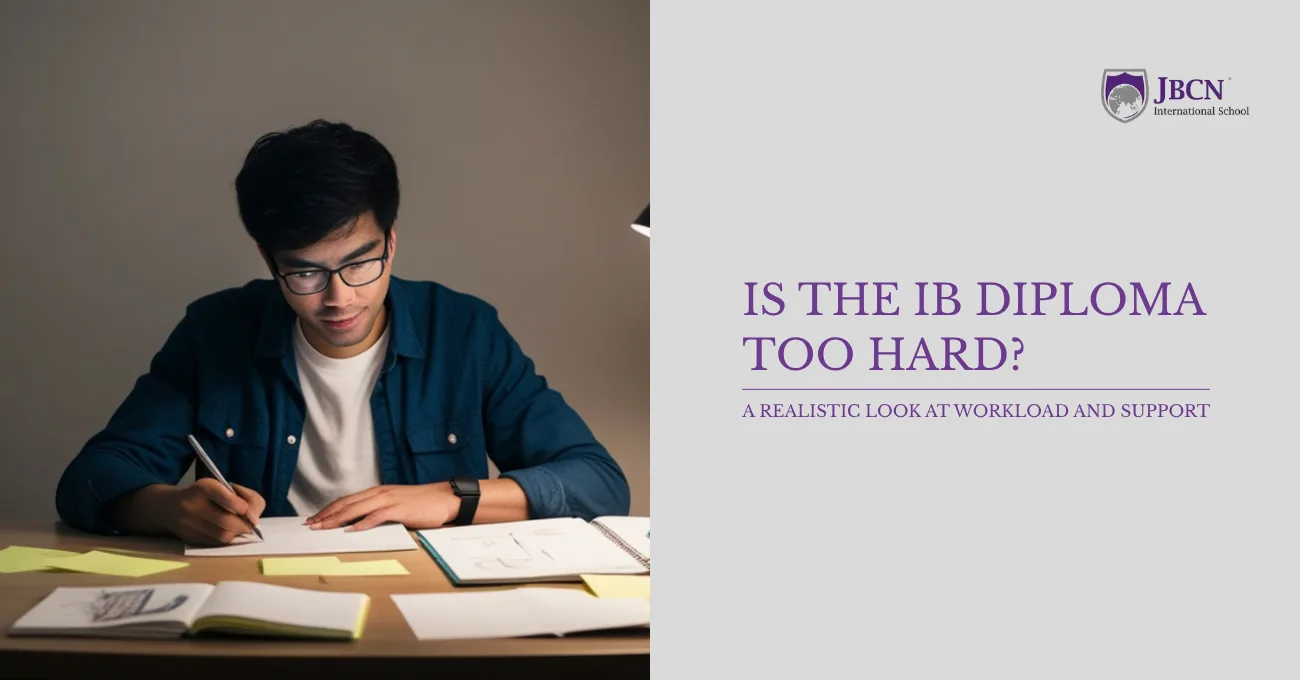
Few questions worry a Grade 10 family more than this one. Is the IB Diploma simply too hard for my child to handle? The honest answer is that the IB Diploma is demanding but very manageable with the right planning and support. Thousands of Learners complete it well every year, and the difference usually lies in how a child is supported, not in raw ability.
What Makes the IB Diploma Demanding
The IB Diploma asks a Learner to study six subjects alongside three core components over two years. That breadth is what makes it rich, and also what makes it feel heavy without good organisation. Knowing exactly what the programme includes removes a lot of the fear.
|
Element |
What It Involves |
|
Six subjects |
Three at Higher Level, three at Standard Level |
|
Theory of Knowledge (TOK) |
A course on how we know what we know |
|
Extended Essay (EE) |
An independent research essay of around 4,000 words |
|
Creativity, Activity, Service (CAS) |
Experiences beyond the classroom over two years |
The IB Diploma Programme combines these into one coherent qualification. The demand comes from balancing them, not from any single part being impossible.
A Realistic Weekly Workload
A realistic IB week involves regular study beyond class time, spread across subjects and the core. Workload varies by Learner, subject choice, and the time of year, with busier stretches around assessments. The key is steady, planned effort rather than last-minute cramming.
Most Learners find the workload manageable once they build a routine and use their time well. A closer, honest picture is shared in what two years of the IB really feels like. The programme rewards consistency far more than long, exhausting nights.
Who Tends to Thrive in the IB
A wide range of Learners thrive in the IB, not only the top of the class. Curiosity, a willingness to manage time, and openness to different subjects matter more than being naturally brilliant. The programme is designed to stretch a broad group of Learners, not to filter out all but a few.
- Curious Learners: those who enjoy asking questions and connecting ideas.
- Organised Learners: those who plan their time, or who learn to with support.
- Open Learners: those willing to study across sciences, humanities, and languages.
- Supported Learners: those in a school that guides workload and wellbeing.
How JBCN Supports Learners Through the Workload
Support is what turns a demanding programme into an achievable one, and JBCN builds it in from the start. The group pairs academic guidance with pastoral care, so a Learner is supported in managing both work and wellbeing. That structure is reflected in JBCN's results.
- Individual planning: JBCN's Strategic Individual Excellence Plan tailors support to each Learner.
- Early counselling: university and careers guidance begins from Grade 9, not the final year.
- Pastoral care: wellbeing and exam-pressure support run through the two years.
- Proven outcomes: JBCN recorded a 100 percent IB pass rate, with Parel averaging 37.6 and Oshiwara 37.8 for the Class of 2026.
JBCN also shares practical guidance on managing exam pressure during the Diploma.
Common Myths About IB Difficulty
Several myths make the IB sound harder than it is, and clearing them up helps families decide calmly. Most of the fear comes from online opinion rather than how the programme actually runs in a supportive school. The clarifications below address the common ones.
- Myth: only the top of the class can pass the IB.
In truth, a broad range of Learners complete it well with support. - Myth: the IB means no free time at all.
In truth, a planned routine leaves room for rest and activities. - Myth: the Extended Essay is impossible.
In truth, it is guided step by step over many months. - Myth: IB stress is unavoidable.
In truth, good pastoral care and planning keep pressure manageable.
Take the Next Step
The best way to judge whether the IB suits your child is to talk it through with people who guide Learners through it daily. If you are weighing the Diploma, the admissions team at your nearest IB campus can explain the workload and the support in detail. A calm, informed conversation often replaces worry with confidence.
Frequently Asked Questions
-
Is the IB Diploma Harder Than Other Curricula?
The IB Diploma is broad and demanding because it combines six subjects with three core components over two years. Whether it feels harder than another curriculum depends on the child, since the IB rewards breadth and consistency. With good support, a wide range of Learners complete it successfully.
-
How Many Hours of Homework Does the IB Diploma Involve?
IB workload varies by Learner, subject choice, and the time of year, with busier periods around assessments. Most Learners study regularly beyond class rather than in long, exhausting bursts. A steady routine usually keeps the workload manageable.
-
Can a Learner Switch Out of the IB Mid-Programme?
Options exist for a Learner who finds the full Diploma is not the right fit, including taking individual certificates rather than the full Diploma. The best step is to talk early with the school's counsellors about the right path. JBCN's pastoral and counselling support helps families make that decision calmly.
-
What Happens If a Learner Does Not Pass the IB Diploma?
The IB Diploma requires a minimum of 24 points, with conditions such as no grade 1 in any subject and minimum totals of 12 points at Higher Level and 9 at Standard Level. A Learner who does not meet the full requirements can still receive certificates for individual subjects completed. Strong school support and early planning make falling short uncommon.
-
Is the IB Too Hard for an Average Student?
No, the IB is designed for a broad range of Learners, not only the highest achievers. Curiosity, organisation, and good school support matter more than being naturally top of the class. JBCN's 100 percent pass rate reflects what structured support makes possible.
-
Does the IB Diploma Cause Too Much Stress?
The IB is demanding, but stress becomes manageable with planning, pastoral care, and realistic routines. Good schools build wellbeing support and exam-pressure guidance into the programme. JBCN provides counselling and pastoral care across the two years to keep pressure in check.
-
What Is the Pass Mark for the IB Diploma?
The IB Diploma is scored out of 45, and a Learner needs at least 24 points to pass, subject to the programme's conditions. The global average sits near 30.9, and JBCN's campuses averaged 37.6 and 37.8 for the Class of 2026. Those figures show that strong results are well within reach with support.
Share