Published on: November 13, 2026
What distinguishes a school that delivers good education from one that continually strives to meet the highest international standards?
It takes more than academic results, impressive infrastructure or a well-designed curriculum. It requires a commitment to evaluating every aspect of the educational experience, from the quality of teaching and learning to leadership, safeguarding, learner well-being and the school's contribution to a global community.
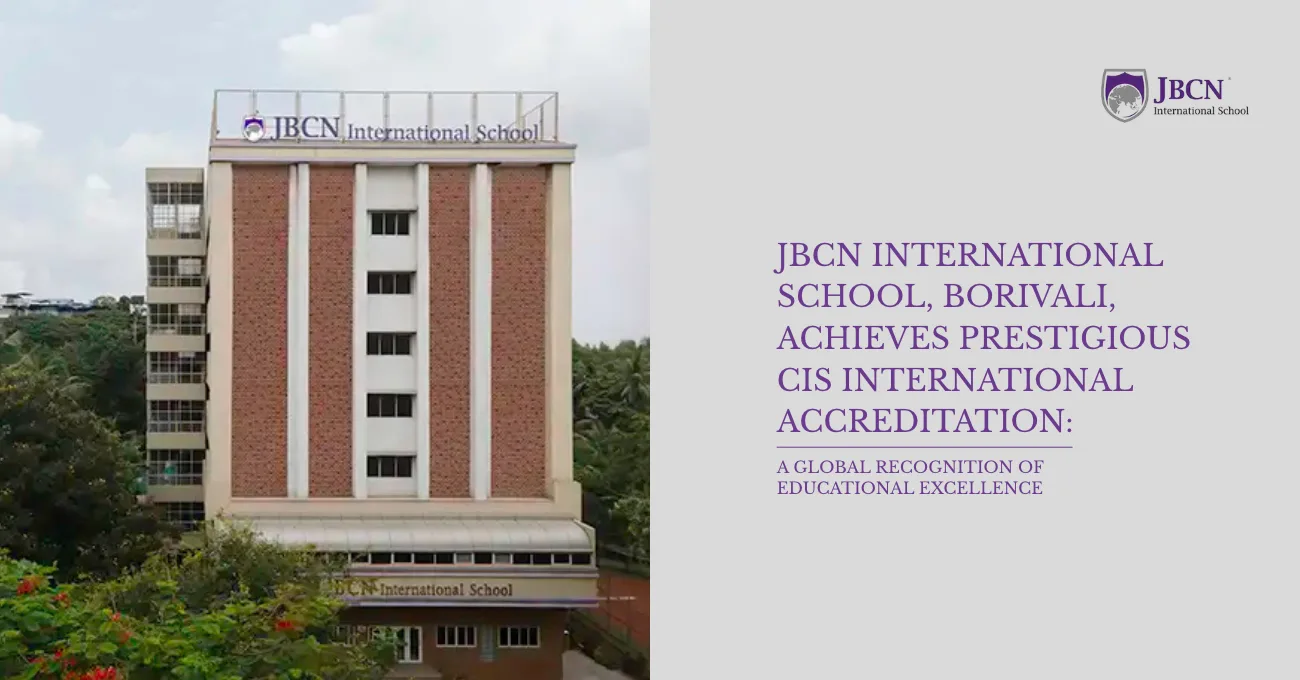
JBCN International School, Borivali, has achieved an important milestone in this journey by receiving International Accreditation from the Council of International Schools (CIS) on 28 October 2026.
This recognition places JBCN Borivali among a select community of internationally accredited schools that have undergone an independent evaluation of their educational practices against globally established standards.
The significance of this achievement becomes even more apparent when viewed in the context of the wider international education landscape. An independent analysis of 11,979 international schools found that only 435 held CIS accreditation, representing approximately 3.6% of the schools tracked in that study.
For JBCN Borivali, this is more than an accreditation milestone. It is an affirmation of the school's commitment to academic quality, meaningful learning, learner well-being and continuous improvement.
But what exactly does CIS accreditation mean? How rigorous is the process? Why is it considered significant in international education? And what does it mean for parents choosing a school for their children?
Let's take a closer look.
What Is CIS Accreditation and Why Is It So Highly Regarded?
The Council of International Schools (CIS) is a global membership community of schools and higher education institutions committed to advancing the quality of international education.
With more than 1,635 schools and universities represented across 120 countries, CIS brings together educational institutions that share a commitment to developing internationally minded, socially responsible and interculturally competent global citizens.
CIS International Accreditation is a quality assurance and distinction framework for primary and secondary schools. It enables institutions to evaluate their educational programmes, practices and outcomes against internationally established standards.
What makes this accreditation particularly significant is its comprehensive approach.
Rather than evaluating a school exclusively on examination results or infrastructure, CIS examines the wider educational environment and how effectively the institution fulfils its purpose.
Its accreditation framework considers areas such as:
- Educational purpose, mission and values.
- Quality of teaching and learning.
- Academic programmes and assessment practices.
- School leadership and governance.
- Safeguarding and child protection.
- Learner well-being.
- Global citizenship and intercultural understanding.
- Institutional planning and continuous improvement.
This makes CIS accreditation an important benchmark for schools that are committed to looking beyond conventional measures of educational performance.
How Rare Is CIS Accreditation Among International Schools?
One of the most interesting aspects of CIS accreditation is its relative rarity.
An independent study published in October 2026 by Appointed examined 11,979 active international schools and compared their accreditation status against the public directories of major international accreditation and inspection organisations.
The findings revealed that:
|
Accreditation finding |
Number |
|
International schools analysed |
11,979 |
|
Schools holding CIS accreditation |
435 |
|
Percentage holding CIS accreditation |
Approximately 3.6% |
In other words, approximately 1 in 28 schools in the study's database held CIS accreditation.
This provides an interesting perspective on the achievement. CIS accreditation is not an automatic recognition associated with school membership. It represents a separate quality assurance process that requires schools to demonstrate that their educational practices meet the organisation's accreditation requirements.
It is important to note that this independent study represents a tracked database of international schools, not a census of every school worldwide.
CIS itself reports that more than 585 member schools have completed its International Accreditation process, reflecting the wider reach of its accreditation community.
For JBCN Borivali, achieving CIS International Accreditation means becoming part of a global community that places considerable importance on educational quality, accountability and continuous improvement.
CIS Membership vs CIS Accreditation: Understanding the Difference
An important distinction in international education is the difference between being a CIS member school and being a CIS-accredited school.
Although the terms are sometimes used interchangeably, they represent different levels of engagement with the organisation.
CIS Membership
Membership gives educational institutions access to a global professional network, resources, events, collaboration opportunities and other services offered by CIS.
It is an opportunity for schools to engage with international education practices and the wider educational community.
CIS International Accreditation
Accreditation goes a step further.
It involves a structured quality assurance process through which a school evaluates its educational practices against CIS standards and undergoes an external evaluation.
This process considers how effectively the institution translates its educational mission into everyday practices and outcomes.
The distinction matters because membership alone does not mean a school has achieved accreditation.
JBCN International School, Borivali, has achieved the latter.
What Does the CIS Accreditation Process Evaluate?
CIS accreditation is designed to encourage schools to examine their educational practices from multiple perspectives.
The framework is built around three interconnected dimensions: Purpose, Practices and Planning.
1. Purpose: Defining What a School Stands For
A school's educational philosophy should be more than a statement on its website.
It should influence the decisions it makes, the learning experiences it creates and the way it prepares learners for the future.
CIS examines how clearly a school defines its mission, values and educational direction, and how effectively these are reflected in its everyday functioning.
This includes the school's commitment to international education, global citizenship and its responsibility towards the wider community.
2. Practices: Turning Educational Intent into Everyday Experiences
A school's quality is ultimately reflected in what happens every day.
The teaching and learning environment, curriculum implementation, assessment, leadership, student support and safeguarding practices all contribute to the quality of education learners experience.
CIS examines these practices to understand whether they are aligned with the school's stated purpose and internationally established expectations.
3. Planning: A Commitment to Continuous Improvement
A high-quality school does not consider its work complete after achieving a particular milestone.
It regularly evaluates its practices, identifies areas that need attention and uses evidence to inform future decisions.
CIS places importance on this culture of continuous improvement.
The emphasis is on ensuring that accreditation becomes part of an ongoing institutional journey rather than a one-time achievement.
Why Learner Well-being and Safeguarding Are Central to CIS Accreditation
Academic excellence is important, but the environment in which learners study and grow is equally significant.
A school must provide an environment where children feel safe, respected, supported and confident enough to participate in their learning.
CIS incorporates recommendations from the International Taskforce on Child Protection into its accreditation protocol, reinforcing the importance of effective safeguarding practices.
This includes the broader responsibility of a school to establish appropriate policies, systems and practices that protect learners.
The framework also recognises the importance of well-being as an integral part of educational quality.
For parents, this is an important consideration. A school's responsibility does not end with delivering a curriculum. It extends to creating an environment where learners can develop academically, socially and personally.
Why Does CIS Accreditation Matter When Choosing an International School in Mumbai?
Parents today have more educational choices than ever before.
When comparing international schools in Mumbai, families often consider examination results, curriculum options, faculty experience, infrastructure, extracurricular opportunities and university pathways.
These are all important factors.
However, there is another question worth asking:
Has the school undergone an independent international evaluation of its educational practices?
CIS accreditation provides an additional quality assurance reference point for parents.
It demonstrates that the school has undertaken a structured process of evaluation against internationally developed standards.
For families considering JBCN International School, Borivali, this achievement reinforces the school's commitment to:
- Maintaining high standards of teaching and learning.
- Creating a safe and supportive learning environment.
- Establishing responsible leadership and governance practices.
- Developing internationally minded learners.
- Evaluating educational practices and identifying opportunities for improvement.
It is important to understand that accreditation does not guarantee university admission or automatically determine academic outcomes. Instead, it provides an independent perspective on the quality and direction of the school's educational practices.
When considered alongside academic performance, curriculum suitability and the individual needs of a learner, it becomes a valuable part of the school-selection process.
JBCN Borivali: Building an Education That Looks Beyond the Classroom
Established in 2009, JBCN International School, Borivali, has continued to build an educational environment that brings together academic rigour, creativity and meaningful learning experiences.
The campus offers multiple academic pathways, including:
- ICSE
- Cambridge IGCSE
- Cambridge AS & A Levels
This allows learners to pursue different academic routes depending on their interests, strengths and future aspirations.
At the heart of the school's educational philosophy is JBCN's EduCreative approach.
EduCreating Changemakers is about developing learners who possess the academic knowledge, skills, perspectives and confidence to make meaningful contributions to the world around them.
The approach places importance on three interconnected dimensions:
Academic Excellence: Developing strong conceptual foundations, subject knowledge, analytical thinking and the ability to apply learning.
Creative Experiences: Encouraging learners to explore ideas, express themselves, innovate and develop individual interests.
Learning Beyond the Classroom: Creating opportunities to connect learning with real-world experiences, collaboration, community engagement and responsible action.
The CIS accreditation adds an important international quality assurance dimension to this educational approach.
It reinforces the importance of ensuring that the school's educational purpose, everyday practices and future priorities remain aligned with internationally recognised expectations.
What Should Parents Look for Beyond International Accreditation?
While CIS accreditation is a significant achievement, parents should evaluate a school through a broader lens.
Here are some important considerations when selecting an international school:
|
What to evaluate |
Questions parents should ask |
|
Academic performance |
What are the school's examination results and academic outcomes? |
|
Curriculum |
Does the curriculum align with my child's interests and future plans? |
|
Teaching quality |
How experienced are the educators, and how is learning supported? |
|
Safeguarding |
What systems are in place to protect learners? |
|
Well-being |
How does the school support the social and emotional development of learners? |
|
University guidance |
What support is available for higher education planning? |
|
Learning opportunities |
Are learners encouraged to explore interests beyond academics? |
|
Accreditation |
Has the school undergone an independent external quality assurance process? |
A well-informed school choice considers all these factors rather than relying on a single ranking, award or accreditation.
CIS accreditation gives parents another important measure when evaluating JBCN Borivali's educational environment.
A Global Recognition. A Commitment That Continues.
Achieving CIS International Accreditation marks an important milestone in the journey of JBCN International School, Borivali.
Being part of a select community of internationally accredited schools reinforces the importance of maintaining high educational standards, continuously evaluating practices and creating meaningful learning experiences.
For JBCN Borivali, this achievement is not simply about receiving an international recognition. It is about strengthening the commitment to an education that combines academic rigour with creativity, responsibility, global awareness and the confidence to make a difference.
Because preparing learners for the future requires more than teaching them what to think. It requires equipping them with the ability to question, understand, create and contribute.
JBCN International School, Borivali. Now CIS Accredited. EduCreating Changemakers.
Explore JBCN Borivali. Discover an education shaped by global standards and driven by the potential of every learner.
Editorial Sources and References
- Council of International Schools – Official announcement: Newly accredited JBCN International School, Borivali, India (29 October 2026).
- Council of International Schools – About CIS and global membership statistics.
- Council of International Schools – International Accreditation framework.
- Council of International Schools – Information for students and parents, including the number of accredited member schools.
- Appointed – CIS, NEASC, WASC and BSO: International School Accreditation Explained (October 2026). Independent analysis of 11,979 international schools.
- JBCN Education – Official website and JBCN Borivali campus information.
Frequently Asked Questions About CIS Accreditation
- What is CIS accreditation in schools?
CIS accreditation is an international quality assurance recognition awarded by the Council of International Schools. It evaluates a school's educational purpose, teaching and learning practices, leadership, safeguarding, learner well-being and commitment to continuous improvement against internationally established standards.
- How many schools have CIS accreditation worldwide?
CIS reports that more than 585 member schools have completed its International Accreditation process. The organisation's wider membership community includes more than 1,635 schools and universities across 120 countries.
- What percentage of international schools have CIS accreditation?
An independent October 2026 analysis of 11,979 international schools identified 435 schools with CIS accreditation, representing approximately 3.6% of the schools in that database. This is an independent dataset and should not be interpreted as a definitive percentage of every school worldwide.
- Is CIS membership the same as CIS accreditation?
No. CIS membership provides access to a global educational network and professional resources. Accreditation is a separate quality assurance process involving a structured evaluation of a school's educational practices against CIS standards.
- Is CIS accreditation internationally recognised?
Yes. CIS states that the quality and rigour of its International Accreditation are recognised by ministries, departments of education and universities in the United States and around the world.
- Does CIS accreditation guarantee admission to international universities?
No. CIS accreditation is a recognition of a school's institutional quality assurance and educational practices. University admission continues to depend on a learner's academic qualifications, subject choices, application and the individual university's admission requirements.
- Is JBCN International School, Borivali, CIS accredited?
Yes. JBCN International School, Borivali, received CIS International Accreditation on 28 October 2026, as confirmed through the Council of International Schools' official announcement dated 29 October 2026.
- What curricula does JBCN Borivali offer?
JBCN International School, Borivali, offers ICSE, Cambridge IGCSE and Cambridge AS & A Levels, providing learners with different academic pathways.
Share