
Published on: September 23, 2026
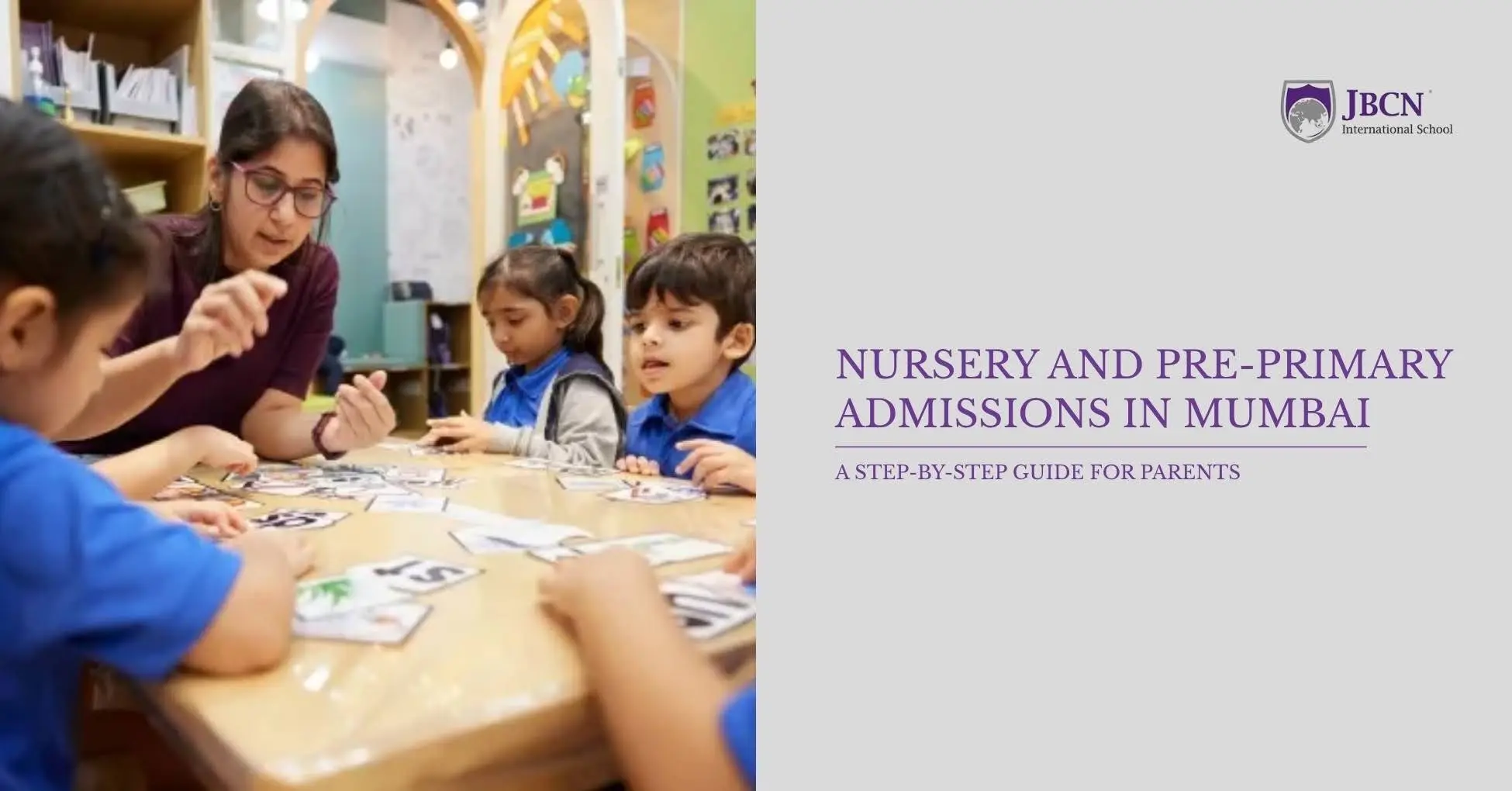
Starting the nursery search in Mumbai can feel surprisingly stressful for a decision about such a small child. Timelines are unclear, age rules differ, and every school describes its early years differently. The process is far more manageable once you know when to start, how age cut-offs work, and what the steps actually are.
Why Starting Early Is Not Optional at Good Mumbai Schools
The best international schools in Mumbai do not hold seats open until March. The admission cycle at premium pre-primary programmes typically runs as follows:
- August: enquiries open and initial registrations begin at most premium schools
- September to October: information sessions and campus visits fill up; waiting lists begin forming at popular schools
- October to November: most seats at sought-after campuses are allocated to families who have completed the process
- December onwards: remaining seats go to waitlisted families or are not available at all
The right approach is to begin shortlisting schools in July or August, attend information sessions in August and September, submit applications before October, and complete the interaction and offer stage before November. Families who follow this timeline have the full set of options. Those who start in January are choosing from what is left.
Nursery and Pre-Primary Age Criteria in Mumbai 2027
Age eligibility works as a minimum age at entry, set by a cut-off date. A child must reach the required age by that cut-off to join a grade. The table below shows the criteria for JBCN Parel for the 2027-28 academic year. Other campuses may set their own dates — always confirm with your chosen campus.
|
Grade |
Minimum Age |
Date of Birth (2027-28) |
|
Nursery |
3 years |
1 January 2024 to 31 December 2024 |
|
Junior KG |
4 years |
1 January 2023 to 31 December 2023 |
|
Senior KG |
5 years |
1 January 2022 to 31 December 2022 |
Cut-off conventions vary: many schools use 31 December, some use 31 July or 31 March. Treat this table as a guide and verify the specific rule with your chosen campus before assuming eligibility.
The Nursery Admission Process, Step by Step
The admission journey follows a clear sequence. Knowing it in advance removes much of the uncertainty — and knowing the timeline tells you when to act.
- Step 1 — Submit an enquiry (August): register your interest with the school. Most premium schools log enquiries and follow up with information session invitations
- Step 2 — Attend an information session (August to September): understand the school's philosophy, curriculum, and early years approach. This is where parents assess fit
- Step 3 — Campus tour (August to October): see the pre-primary classrooms, outdoor spaces, and facilities in person. No brochure substitutes for this
- Step 4 — Complete the application form (September to October): submit the formal application with required documents — birth certificate, photographs, address proof
- Step 5 — Friendly interaction (October to November): a relaxed conversation to get to know your child. Not a test or assessment. No preparation needed
- Step 6 — Offer of admission (October to November): an offer is made where there is a fit and availability. This is not guaranteed — it depends on seats remaining and the school-family fit
What to Look for in a Pre-Primary Curriculum
The early years shape how a child feels about learning for the rest of their school life. The curriculum's approach matters more than any single facility.
Inquiry-Led vs Content-Led
An inquiry-led early years programme starts with a child's natural curiosity — questions, exploration, play with purpose. A content-led programme covers a syllabus of skills in a structured sequence. Both can be effective, but the inquiry approach tends to build stronger intrinsic motivation. Ask how a typical morning unfolds rather than looking at a curriculum document.
Play as Learning
In the best pre-primary programmes, play is not a break from learning — it is how learning happens. Look for outdoor play, creative exploration, and unstructured discovery time built into the school day, not squeezed in at the edges.
Adult-to-Child Ratio
The number of adults per child in Nursery and KG directly affects how much individual attention your child receives. Ask the specific ratio rather than accepting a general answer about small classes.
Language and Communication
Early language development — listening, speaking, early reading, and phonics — sets the foundation for all future academic learning. Ask what specific approach the school takes, not just whether they teach it.
Transition to Primary
How does the school move a child from KG into Grade 1? A strong programme has a deliberate transition plan, not just a new classroom. Ask whether there is an orientation, a buddy system, or any support for children who find the change difficult.
Questions to Ask on a Pre-Primary School Visit
A campus visit is the most important step in the process. Come with these questions ready — the answers tell you far more than a brochure.
|
Topic |
Question to Ask |
|
Curriculum |
What curriculum do the early years follow, and how does it connect to the primary programme? |
|
Classroom ratio |
What is the adult-to-child ratio in Nursery and KG? |
|
Transition |
How do children move from pre-primary into Grade 1 — is there a transition programme? |
|
Language support |
How is early language development supported — reading, phonics, and communication? |
|
Outdoor play |
How much unstructured outdoor play time is built into the day? |
|
Parent communication |
How will we know how our child is progressing — reports, meetings, or daily updates? |
|
Seat availability |
Are seats still available for the grade my child is entering, and what is the timeline? |
|
Full fee structure |
What is the complete annual fee including all extras — transport, uniform, activities? |
Enquire Now — Seats Fill by October
Register your interest with the campus nearest to you and secure your place in the information session queue:
- JBCN Parel — IB PYP from Nursery
- JBCN Oshiwara — IB PYP from Nursery
- JBCN Chembur — IB PYP from Nursery
- JBCN Borivali — Cambridge Primary from Nursery
- JBCN Mulund — Cambridge Primary from Nursery
Or speak with our admissions team to be directed to the right campus for your family.
Frequently Asked Questions
-
When do nursery admissions open in Mumbai?
Most premium international schools open nursery enquiries from July onwards for the following academic year (June 2027 start). Information sessions and campus visits fill between August and October. Seats at popular schools are typically allocated by November. Waiting until January significantly reduces the options available — the families who secure their preferred school are those who begin in July or August.
-
What is the right age to start Nursery in Mumbai?
Nursery has a minimum age of 3 years, meaning a child must turn 3 by the school's cut-off date. For the 2027-28 year at JBCN Parel, Nursery is for children born between 1 January and 31 December 2024. Cut-off dates vary between schools — some use 31 July, some 31 December, some 31 March. Always confirm with your chosen campus before assuming eligibility.
-
Do seats at Mumbai's top international schools really fill by October?
Yes. Premium international schools in Mumbai receive significantly more enquiries than they have pre-primary seats. Information sessions and interactions are scheduled from August through October, and offers are typically made by November. A family that begins enquiring in January is usually choosing from a very limited set of remaining options or joining a waiting list. This is a structural reality of demand at popular schools, not a sales tactic.
-
What is the IB PYP at nursery level?
The IB Primary Years Programme (PYP) is an inquiry-based curriculum that organises learning around six transdisciplinary themes. At nursery level, this means children learn through structured play, investigation, and exploration rather than a content-delivery approach. A PYP Nursery classroom asks questions like 'Where do we belong?' and lets children explore the answer through storytelling, art, outdoor play, and collaborative activity. The IB PYP runs from Pre-Nursery through Grade 5 at JBCN Parel, Oshiwara, and Chembur.
-
What is the difference between IB PYP and ICSE at pre-primary level?
At pre-primary level both approaches build literacy, numeracy, motor skills, and social confidence — the difference is in method. IB PYP is inquiry-based and transdisciplinary: learning flows from a child's curiosity and crosses subject boundaries. ICSE at pre-primary is more structured and subject-defined, building strong foundational habits in language and numeracy. JBCN offers IB PYP at Parel, Oshiwara, and Chembur, and an ICSE foundation at Borivali and Mulund.
-
Does JBCN guarantee admission after the interaction?
No. The process concludes with an offer of admission where there is a fit and a seat available — not a guaranteed place. The interaction is a friendly, relaxed conversation to get to know your child, not a test or assessment. No preparation or rehearsal is needed. The earlier you complete the process, the more likely a seat is still available.
-
What documents are needed for nursery admission?
Schools typically ask for the child's birth certificate, recent photographs, and address proof, though exact requirements vary and can change year to year. Confirm the current checklist directly with the campus. Having documents ready in advance speeds up the process — particularly important given the October timeline.
-
Which JBCN campuses offer IB PYP at pre-primary level?
Parel, Oshiwara, and Chembur run the IB Primary Years Programme from Nursery onwards. Borivali and Mulund offer a pre-primary foundation leading into the Cambridge Primary and ICSE pathway. All five campuses share the same EduCreative philosophy and group-wide standard of care.
Share