Published on: June 11, 2026
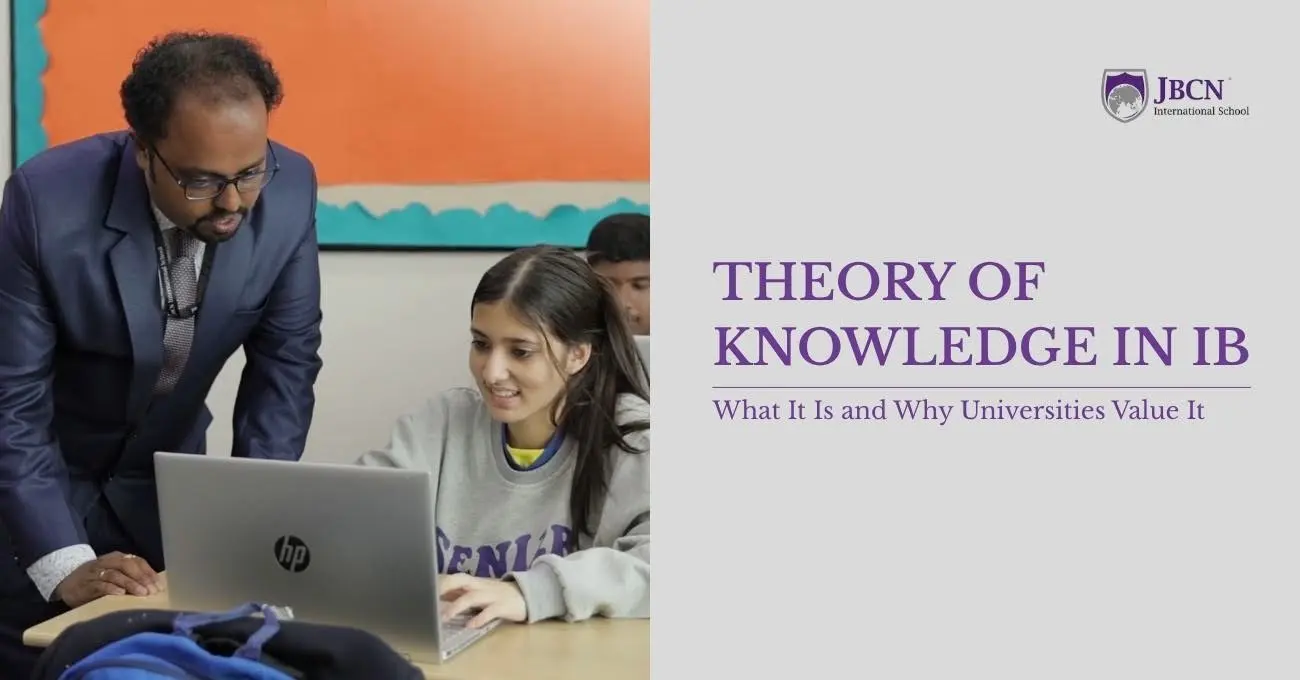
Most school subjects ask one question: what do you know? Theory of Knowledge asks a more unusual question: how do you know it? For many parents, that shift is the first thing that feels different about the International Baccalaureate (IB), and the part that takes a little explaining.
Here is the Theory of Knowledge in IB set out clearly, what it is, how it is assessed, and why universities value it.
What is the Theory of Knowledge in IB?
Theory of Knowledge (TOK) is one of the three core parts of the IB Diploma Programme, sitting alongside the Extended Essay (EE) and Creativity, Activity, Service (CAS). Every Diploma Learner takes it, across roughly 100 hours over the two years. Rather than teaching new facts, TOK asks Learners to think more carefully about what they already know.
The course turns on a single question: how do we know what we claim to know? In place of right answers, it builds the habit of weighing evidence, testing assumptions, and seeing an issue from multiple angles. Because it draws on every other subject, TOK also ties the diploma together, helping Learners connect what they study across the curriculum.
What Does the TOK Course Cover?
TOK is built around themes and areas of knowledge, explored through guided knowledge questions. The course has a clear shape, even if the questions inside it stay open.
Themes: Knowledge and the Knower
At the centre sits one core theme, Knowledge and the Knower, which asks Learners to reflect on themselves as thinkers. Schools then choose two optional themes from five: knowledge and technology, language, politics, religion, and indigenous societies.
The Five Areas of Knowledge
Learners examine how knowledge works across five compulsory areas of knowledge (AOKs): history, the human sciences, the natural sciences, mathematics, and the arts. Each field builds and tests knowledge differently, which is exactly the point. A shared knowledge framework, covering scope, perspectives, methods, and tools, and ethics, runs through every theme and area, helping Learners compare how different subjects arrive at what they know.
A few example knowledge questions show the flavour:
- In mathematics, did humans invent numbers or discover them?
- In history, how do we decide what really happened when the evidence is incomplete?
- In the arts, can a painting express something words cannot?
- In the natural sciences, how much evidence is enough to call something a fact?
The 12 Key Concepts of TOK
Running beneath the themes and areas are twelve key concepts that the course uses as recurring lenses. Learners return to them whenever they question how a piece of knowledge is built and judged. None has a single fixed answer; each is simply a way to probe a claim, asking, for instance, what counts as good evidence or whether true objectivity is ever possible.
The twelve concepts are:
- Evidence: what counts as support for a claim.
- Certainty: how sure can we really be?
- Truth: whether a claim matches reality.
- Interpretation: how context shapes meaning.
- Power: how knowledge can shape and control.
- Justification: the reasoning behind a claim.
- Explanation: how we make sense of things.
- Objectivity: the effort to keep bias out.
- Perspective: the viewpoint a knower brings.
- Culture: how shared values shape what we know.
- Values: the principles that guide judgement.
- Responsibility: the duties that come with knowing.
How Is TOK Assessed?
TOK has two assessments, and together they can add up to three points to the final diploma score. The essay carries the larger share, the exhibition the rest.
| Component | When | Format | Marked |
|---|---|---|---|
| TOK Exhibition | Year 1 | Three real-world objects with a commentary of about 950 words | Internally, about a third |
| TOK Essay | Year 2 | One of six set titles, about 1,600 words, using two areas of knowledge | Externally, about two-thirds |
An exhibition prompt might ask what counts as good evidence for a claim, while an essay title poses a broader question explored through two areas of knowledge.
Both grades combine with the Extended Essay on a scale from A to E to award up to three bonus points. A failing grade in TOK can put the whole diploma at risk, so it is taken seriously from the start.
What Skills Does Theory of Knowledge Develop?
One reason TOK is such an important part of the IB Diploma is that the skills it develops extend far beyond the classroom. The course encourages Learners to become more thoughtful, analytical, and confident in the way they approach information and ideas.
Through TOK, Learners develop:
- Critical thinking involves questioning assumptions and evaluating the strength of evidence.
- Communication skills through discussions, presentations, and structured arguments.
- Research and analysis skills involve comparing sources and examining different viewpoints.
- Reflection and self-awareness by considering how personal experiences and beliefs shape understanding.
- Independent thinking by learning to form balanced conclusions rather than accepting information at face value.
These skills support success across the IB Diploma and often prove equally valuable at university, where Learners are expected to analyse information, defend their ideas, and engage with complex questions independently.
Why Universities Value the Theory of Knowledge
Universities value Theory of Knowledge because it builds the exact skills that higher study demands. Long before a Learner writes a dissertation, TOK has them weighing evidence and arguing a position with care.
The habits it develops translate directly to university work:
- Critical thinking, judging how strong a claim or source really is.
- Structured argument is the backbone of essays and exams.
- Comfort with more than one perspective is useful across every discipline.
- Reflective, independent thinking that interviews and seminars reward.
Strong TOK skills also help in admissions interviews and entrance assessments, where the ability to reason out loud stands out.
For a wider view of how these strengths play out, how IB Learners fare at university is worth a read.
Getting the Most from TOK
TOK rewards genuine engagement more than polished answers. A few simple habits help a Learner get the most from it.
- Choose essay titles and exhibition objects that spark real interest, since authentic curiosity shows in the work.
- Look at more than one side of a question rather than defending a single view.
- Use specific, well-chosen examples instead of broad generalisations.
- Keep a simple journal of interesting knowledge questions that come up in other subjects.
How TOK Is Taught at JBCN
At JBCN International School, Theory of Knowledge is part of the IB Diploma offered at the Parel, Oshiwara, and Chembur campuses. Lessons lean on discussion and debate rather than lecture, so Learners practise building and defending a view rather than memorising one.
TOK sits naturally alongside the Extended Essay and CAS, encouraging Learners to make connections across subjects and think deeply about the world around them. At JBCN, TOK reflects the school's EduCreative philosophy by nurturing curiosity, critical thinking, reflection, and independent thought. Through discussion-led learning and inquiry-based exploration, Learners are encouraged to question assumptions, evaluate evidence, and develop the confidence to express well-reasoned perspectives.
For a fuller picture of where the diploma leads, the benefits of the IBDP are worth a read.
Begin the Conversation
Seeing TOK in action, a room of Learners questioning each other's reasoning, says more than any guide can. The best way to understand it is to visit and watch.
Speak with our admissions team or visit a campus to see how the IB Diploma works at JBCN.
Frequently Asked Questions
-
Q. What is TOK in IB?
TOK, or Theory of Knowledge, is one of the three core components of the IB Diploma, alongside the Extended Essay and CAS. Rather than teaching facts, it explores how we know what we claim to know, and is taken by every Diploma Learner.
-
Q. Is Theory of Knowledge a philosophy course?
Not quite. TOK borrows some tools from philosophy, but its focus is on how knowledge works across all subjects, from science to history to the arts, rather than abstract philosophy on its own.
-
Q. Why is TOK compulsory in the IB Diploma Programme?
TOK is compulsory because it encourages Learners to think critically about knowledge across all subjects. It helps connect different parts of the IB Diploma and develops the analytical and reflective skills that universities value.
-
Q. How is TOK graded?
TOK is graded from A to E across two tasks, an exhibition and an essay. Combined with the Extended Essay, it can add up to three bonus points to the final diploma score, and a failing grade can affect the diploma itself.
-
Q. How many hours is the TOK course?
TOK runs across both years of the IB Diploma and involves around 100 teaching hours. Much of that time is spent in discussion rather than traditional lessons.
-
Q. Do universities care about TOK?
Yes. Universities value the critical thinking, structured writing, and reflective skills that TOK builds, which is why those abilities help in essays, interviews, and entrance assessments.
-
Q. What is the TOK exhibition?
The exhibition is an internally marked task, usually in Year 1, where a Learner links three real-world objects to a knowledge question and explains the connection in a commentary of about 950 words.
Share