Published on: May 8, 2026
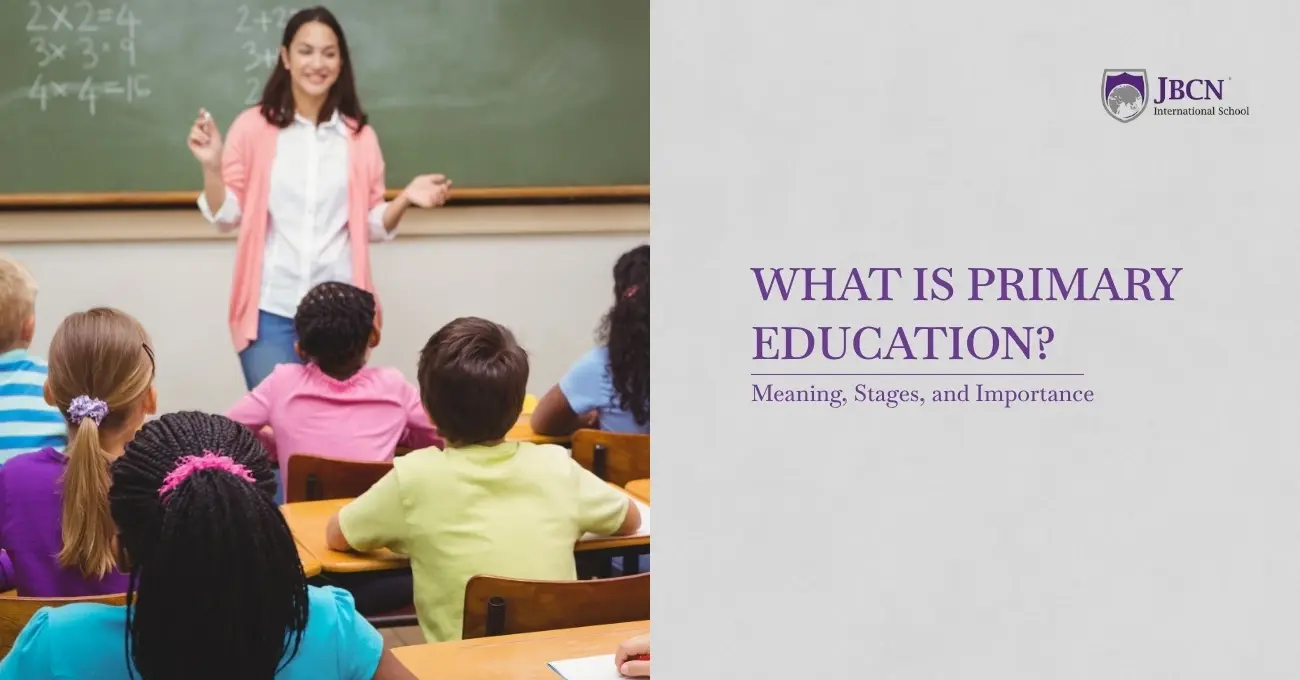
Few decisions feel as important as choosing where a child spends Grades 1 to 5. Primary education shapes how children read, reason, and approach a classroom as independent learners. Most parents have heard the term countless times, but few stop to ask what primary education really covers and why this stage carries such weight.
What Is Primary Education?
Primary education is the foundational stage of formal schooling, covering Grades 1 to 5, where children aged 6 to 11 build core academic, social, and emotional skills. Sitting between pre-primary and middle school, the curriculum focuses on literacy, numeracy, scientific curiosity, and the habits of independent study.
A well-structured primary programme helps children transition smoothly from play-based preschool learning to more structured lessons in languages, mathematics, science, and the arts.
What are the Stages of Primary Education
Primary education broadly covers Grades 1 to 5, with each year gradually building greater independence, confidence, inquiry, and conceptual understanding.
During these years, children move from learning foundational reading and numeracy skills to handling more structured classroom discussions, problem-solving, research, and collaborative learning experiences.
Across the primary years, learners typically show progress in:
- Reading and comprehension
- Structured writing and communication
- Mathematical reasoning and application
- Scientific curiosity and inquiry
- Collaboration and social confidence
- Independent thinking and classroom responsibility
In schools offering frameworks such as the IB Primary Years Programme, learners are also encouraged to develop research, presentation, and reflective thinking skills from an early age.
Key Milestones Across the Primary Years
A few markers indicate healthy progress:
- Reading independently for pleasure by Grade 3
- Writing a short composition with a clear structure by Grade 4
- Solving multi-step word problems by Grade 5
- Expressing ideas confidently during classroom discussions and presentations by Grade 5
Children develop at their own pace, so these should be viewed as broad indicators rather than strict expectations.
Importance of Primary Education
The importance of primary education comes down to one idea: foundations are easier to build than to repair later. The skills a child develops here carry forward into Grade 6 and beyond.
A strong primary stage supports:
- Academic foundations in language, mathematics, science, and reasoning
- Social and emotional confidence
- Curiosity, creativity, and communication skills
- Independent thinking and problem-solving
- A healthy relationship with learning
These years also prepare learners for future pathways such as ICSE, IGCSE, A Levels, and the IBDP.
Why the Foundation Years Matter Most
The primary years are when the brain is most receptive to forming durable habits. A child who reads regularly and works through problems independently at this age builds patterns that often continue naturally over time.
The habits that take shape here are remarkably important:
- Attention and classroom focus
- Vocabulary, grammar, and comprehension
- Logical reasoning and analytical thinking
- Curiosity and persistence
- Confidence in communication and participation
Children who enter middle school with strong foundations generally adapt more confidently to increasing academic expectations.
What Should Parents Look for in a Primary School?
When evaluating a primary school in Mumbai, parents should look beyond infrastructure and brochures. The quality of teaching, classroom environment, and overall learning philosophy matter far more during these formative years.
A strong primary school usually offers:
- Experienced educators trained in child development
- Reasonable class sizes for personalised attention
- A balance between academics and creativity
- Strong literacy and numeracy foundations
- Sports, arts, and co-curricular opportunities
- Emotional well-being and learner support
- Inquiry-led and engaging classroom experiences
The best primary schools focus not only on academic achievement but also on helping children become confident and curious learners.
How JBCN Approaches Primary Education
At JBCN, primary education is anchored in academic rigour and shaped by the EduCreative philosophy. Learners follow the IB Primary Years Programme at Parel, Oshiwara, and Chembur, and the Cambridge Primary pathway at Borivali and Mulund. Both pathways are taught by educators trained in inquiry-led pedagogy, and class sizes stay deliberately manageable so each child is genuinely seen.
At JBCN, classrooms are designed around inquiry-led learning rather than rote memorisation. Lessons often begin with discussion, observation, or exploration, helping children build conceptual understanding instead of simply recalling definitions.
Strong literacy and numeracy development remain central to the primary years, while the iPROPEL programme integrates sports, performing arts, leadership, and skill-building opportunities alongside academics.
Educators continuously observe each child’s progress and adapt support, pace, and challenge where required. Children leave Grade 5 as confident readers, independent thinkers, and collaborative learners.
Explore Primary Learning at JBCN
Visiting a classroom often tells parents more than a brochure ever can. Across Borivali, Parel, Oshiwara, Chembur, and Mulund, JBCN’s primary years programmes are designed to help children build confidence, curiosity, and strong academic foundations from an early age.
FAQs
-
What is primary education in simple terms?
Primary education is the first stage of formal schooling, covering Grades 1 to 5 for children aged 6 to 11.
-
Why is primary education important?
Primary education develops foundational academic, social, emotional, and communication skills that support future learning and confidence.
-
At what age does primary education start in India?
Primary education usually begins at age 6, when children enter Grade 1.
-
What subjects are taught in primary school?
A typical curriculum covers English, mathematics, science, social studies, languages, arts, and physical education.
-
How do I choose the right primary school in Mumbai?
Look for experienced educators, a clear curriculum, manageable class sizes, and a learning environment that balances academics with creativity and learner wellbeing.
Share