Published on: November 27, 2026
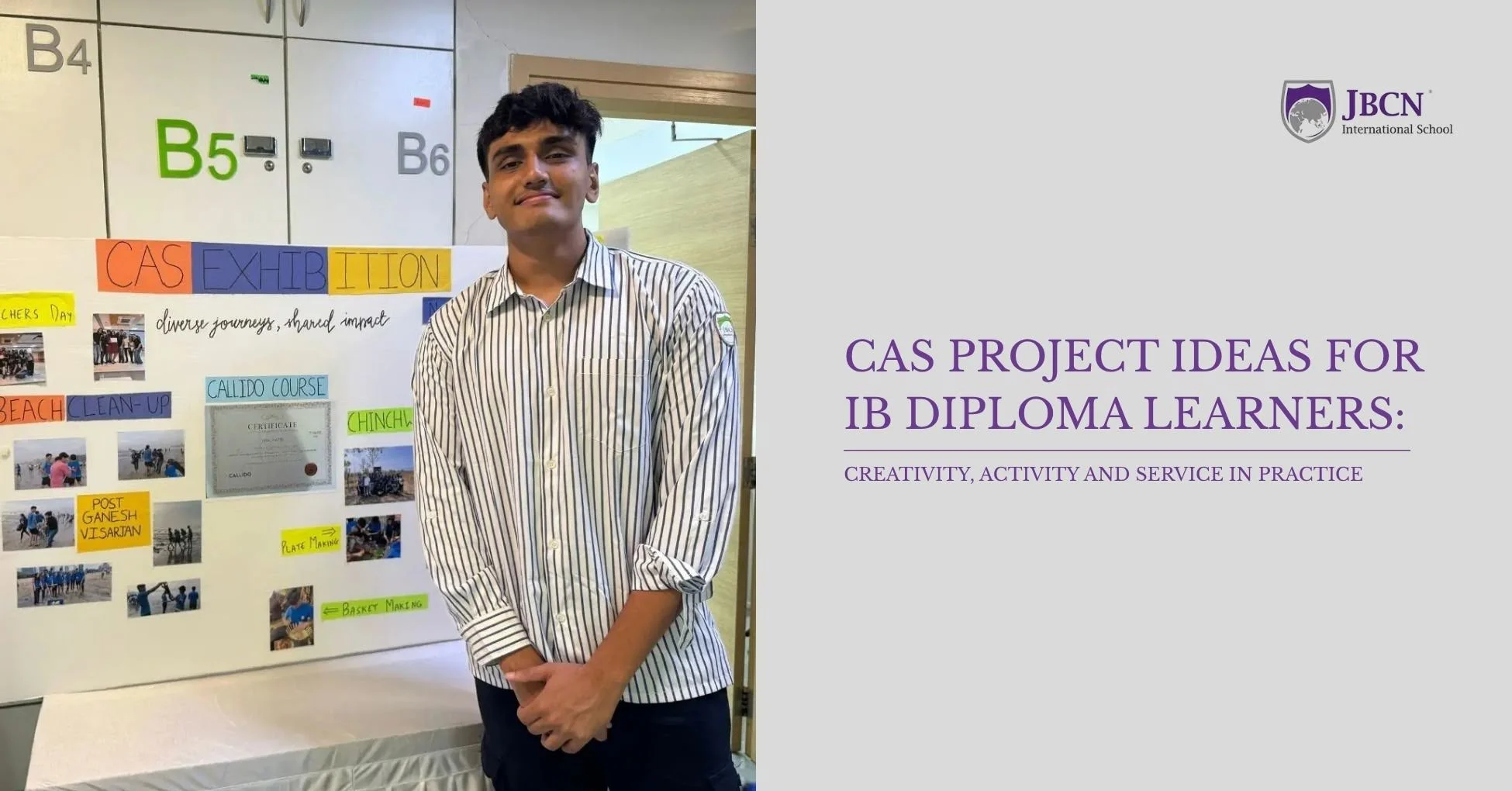
Every IB Diploma Learner must complete CAS, and almost everyone starts from the same blank page. The requirement itself is clear enough. What is rarely clear is what actually counts, how ambitious a project needs to be, and where to begin when nothing on a generic list feels like yours. What follows is a working menu of CAS project ideas, grouped by strand, alongside real projects JBCN Learners have run in Mumbai.
What CAS Requires and How It Is Assessed
CAS stands for Creativity, Activity, Service, and it is one of the three core components of the IB Diploma Programme, alongside Theory of Knowledge and the Extended Essay. CAS carries no grade and no points towards the 45-point total. Completing it is still a condition of the Diploma, so a Learner who does not finish CAS does not receive the award, however strong their subject grades are.
The Three Strands
Each strand asks for something different, and most Learners find one comes easily and another does not.
- Creativity: exploring and extending ideas towards an original or interpretive product, from visual art and composition to writing and design.
- Activity: physical exertion that contributes to a healthy lifestyle, including organised sport, trekking, dance, yoga, or a personal training goal.
- Service: unpaid, voluntary work of genuine benefit to a community, undertaken with that community rather than for it.
How Long CAS Runs
Duration, not hours, is what the IB asks for. CAS begins at the start of the Diploma and continues every week for at least 18 months, summer break included, with a reasonable balance across the three strands.
- No minimum hours: the IB sets no hour requirement, so logging 150 hours is no longer the measure of completion.
- The real measure: evidence that all seven learning outcomes have been met, recorded in a CAS portfolio.
- Why spread matters: commitment and perseverance cannot be evidenced by work compressed into one term.
The Seven Learning Outcomes
Completion rests on achieving all seven outcomes, with evidence of each provided at least once. A single experience need not reach all of them.
- Strengths and growth: identify own strengths and develop areas for growth.
- Challenge and new skills: demonstrate that challenges have been undertaken, developing new skills in the process.
- Initiative and planning: demonstrate how to initiate and plan a CAS experience.
- Commitment: show commitment to and perseverance in CAS experiences.
- Collaboration: demonstrate the skills and recognise the benefits of working collaboratively.
- Global significance: demonstrate engagement with issues of global significance.
- Ethics: recognise and consider the ethics of choices and actions.
What Makes a CAS Project Different From a CAS Experience
A CAS experience can involve one or more strands and may be a single event. A CAS project is the more demanding thing, and every Learner must complete at least one.
- Collaborative: a project is worked on with others, never alone.
- Sustained: a series of sequential experiences running for at least one month.
- Multi-strand: IB guidance is that a CAS project combines two or three of the strands.
- Five stages: investigation, preparation, action, reflection and demonstration.
- Approved: project plans are discussed with the CAS Coordinator before work begins.
Creativity Project Ideas
Creativity rewards originality and process rather than polish, which makes it a forgiving strand to start with. The strongest projects usually grow from a skill a Learner already has and wants to push further. JBCN's own Creativity, Activity and Service programme runs much of this through learner-led clubs.
- Run a club across a term: JBCN Learners have led an Art Club, Dance Club, Music Mania Club and a Book and Literature Club, each needing a term of planning rather than a single session.
- Mount a production: a play, recital or showcase, where rehearsal schedules and a performance date supply the sustained commitment CAS asks for.
- Build something designed: a school magazine, podcast series, mural or exhibition with a defined run.
- Teach the skill on: a beginners' workshop in an instrument, drawing or photography, run for younger Learners over several weeks.
- Creative work with a purpose: a production or publication supporting a cause, which lets Creativity and Service combine honestly.
Activity Project Ideas
Activity asks for physical exertion and progress, not competitive success, so a beginner training towards a modest goal evidences the outcomes as well as a school athlete does. Projects work best when something measurable sits at the end of them.
- Train towards a target: a distance run, swim or cycle, logged across months rather than weeks.
- Join a sustained programme: JBCN Learners have used trekking and yoga, both of which build naturally across a season.
- Coach or organise: running an inter-house tournament or a fitness group for peers, which adds the planning outcome.
- Pick up something unfamiliar: a martial art, a racquet sport or a dance form never tried before, which covers the new-skill outcome cleanly.
- Combine with service: a sports development programme for community members without access to coaching, which JBCN lists among its own CAS work.
Service Project Ideas
Service carries the most weight in CAS and is where Learners most often struggle to find a real partner. The requirement is unpaid work of genuine benefit, planned with the community it serves rather than delivered at it. JBCN's established Mumbai partnerships give Learners a credible starting point rather than a cold search.
- Work with a partner organisation: JBCN Learners have worked with Welfare of Stray Dogs, the Jai Vakeel Foundation, and the dJED Foundation on watershed management in Chinchwadi village.
- Environmental campaigns: beach clean-up drives and tree plantation campaigns, both of which JBCN runs and both of which need organising rather than simply attending.
- Collection and redistribution: book and toy donation programmes, which suit Learners who prefer logistics to front-facing work.
- Peer and community tutoring: structured tutoring of younger Learners or children at a nearby municipal school, sustained across a term.
- Service-focused clubs: Ecospire, Outreach Oasis and the Interact Club at JBCN exist to run exactly this kind of work.
- Where to look first: JBCN has practical guidance on finding volunteer opportunities for your child.
How to Match an Idea to the Learning Outcomes
Most Learners pick an idea they like and only later work out whether it evidences anything. Running that check in advance saves a scramble in Grade 12. The table below maps four realistic Mumbai projects against the strands they combine and the outcomes they can reasonably evidence.
|
Project Idea |
Strands Combined |
Outcomes It Can Evidence |
|
Coaching a weekly sports session for children without access to training |
Activity and Service |
Initiative and planning, commitment, collaboration |
|
A photo exhibition on coastal waste, run with a clean-up drive |
Creativity and Service |
Global significance, ethics, collaboration |
|
Teaching reading at a municipal school across two terms |
Service |
Commitment, ethics, strengths and growth |
|
Training a beginners' group for a charity run |
Creativity, Activity and Service |
Challenge and new skills, collaboration, initiative |
How to Structure a CAS Portfolio Across Grade 11 and Grade 12
The portfolio is the record of those 18 months, holding a profile, the experiences themselves and the evidence behind each outcome. Spreading work across both years is not an administrative preference; it is what makes commitment evidenceable at all. The sequence below causes the fewest problems in Grade 12.
|
Stage |
Focus |
What Should Exist by the End |
|
Early Grade 11 |
Choosing experiences across all three strands |
A rough plan naming activities per strand |
|
Mid Grade 11 |
Starting the CAS project, first reflections |
Project partners agreed, reflections begun |
|
Late Grade 11 |
Sustaining commitments, filling outcome gaps |
Most of the seven outcomes evidenced |
|
Early Grade 12 |
Completing the CAS project |
Project finished, reflection recorded |
|
Mid Grade 12 |
Final interview and portfolio sign-off |
A complete portfolio spanning both years |
Grade 11, Getting Started Properly
The early months matter more than they appear to, because anything sustained has to begin early enough to be sustained.
- Pick across strands first: one commitment per strand prevents a scramble later.
- Start the project early: a month is the minimum, not the target.
- Reflect as you go: short reflections written at the time beat a reconstruction written in Grade 12.
Grade 12, Finishing Without a Scramble
Grade 12 brings Internal Assessments, the Extended Essay and university applications at once, so CAS should largely sit behind a Learner by then.
- Close the project: finish and reflect before application season peaks.
- Audit the outcomes: check all seven against the portfolio and fill only the real gaps.
- Use it in applications: sustained service and leadership give concrete material for essays and interviews.
- Where the Diploma runs: CAS sits in the Diploma core at Parel, Oshiwara and Chembur.
- Further reading: parent's guide to CAS.
- In practice: its account of CAS and clubs as leadership building.
Enquire Now
CAS tends to be the part of the Diploma Learners remember years later, and the right partnerships make the difference between a box ticked and something genuinely theirs. To see how CAS runs day-to-day, the admissions team can arrange a campus conversation.
Enquire about the IB Diploma at JBCN Parel
Frequently Asked Questions
-
What Counts as a CAS Project in the IB Diploma?
A CAS project is a collaborative undertaking made of sequential experiences, running for at least one month, and built around investigation, preparation, action, reflection and demonstration. Working alone does not qualify, nor does a single day of activity. IB guidance is that a project combines two or three of the CAS strands.
-
How Many CAS Hours Are Required?
The IB sets no minimum number of CAS hours. The requirement is that CAS runs on a weekly basis for at least 18 months across the Diploma and that the portfolio evidences all seven learning outcomes, so duration and evidence matter rather than an hour count.
-
Can One Project Count for More Than One CAS Strand?
Yes, and for the CAS project, that is the expectation. A photo exhibition tied to a clean-up drive evidences both Creativity and Service, and a coaching programme for an under-served community covers Activity and Service. Reflections need to show how each strand was genuinely involved.
-
What Happens if a Learner Does Not Complete CAS?
Unmet CAS requirements are a condition under which the Diploma is not awarded, so an incomplete CAS programme means no Diploma even when subject grades are strong. CAS itself carries no grade and adds no points, which is why it is best treated as a deadline rather than a competition.
-
Does JBCN Help Source Service Partnerships?
Yes. JBCN runs established partnerships including Welfare of Stray Dogs, the Jai Vakeel Foundation and the dJED Foundation, alongside learner-led clubs and CAS trips, and Learners are also encouraged to start service projects of their own.
-
Which JBCN Campuses Offer the IB Diploma and CAS?
The IB Diploma Programme and CAS with it, runs at JBCN Parel, Oshiwara and Chembur. CAS is delivered as part of the Diploma core at each of those campuses.
-
Does a CAS Project Need Approval Before Starting?
Yes. Project plans are discussed with the school's CAS Coordinator before work begins, which is also the point at which a Learner finds out whether the idea is sustained and collaborative enough to qualify.
-
How Does CAS Help with University Applications?
Sustained service, leading a club, and a completed collaborative project give admissions readers evidence of commitment over time rather than a list of one-off activities. That record gives essays and interviews something concrete to draw on.
Share