
Published on: August 7, 2026
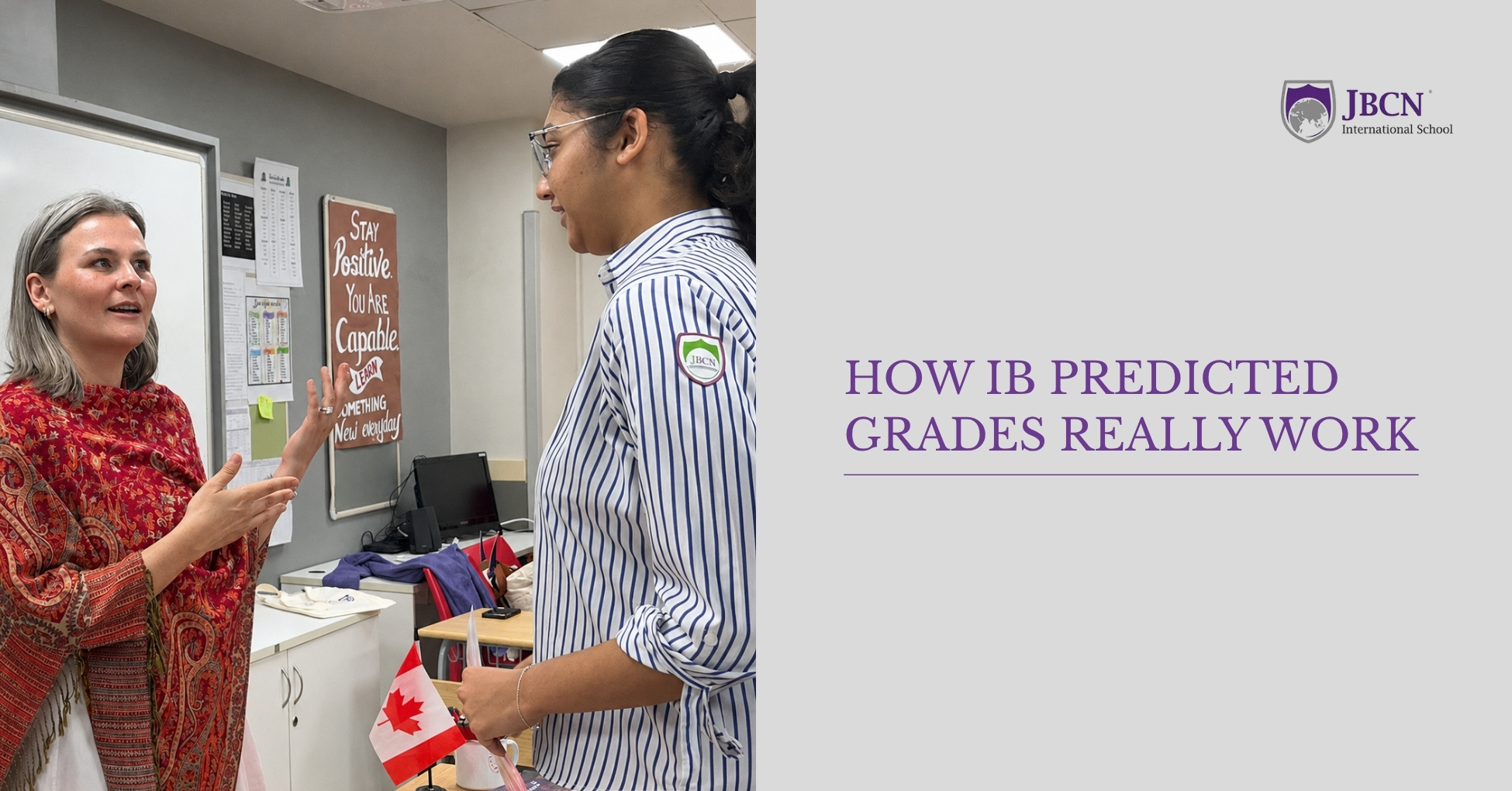
Predicted grades are your teachers’ formal estimate of the grade you are likely to achieve in each IB subject. They are submitted to universities before your actual results are available, and for UK applications in particular, they are the primary academic data a university sees when making you an offer.
For a significant portion of your university journey, you are your predicted grades.
Who Decides and How
Your subject teachers make the initial assessment based on:
- Internal Assessment performance: Your IA score is completed before predicted grades are submitted and carries real weight.
- Mock examination results: Most schools treat mocks as the most significant input. A student who scores a 6 in mocks will typically be predicted a 6 or 7. A student who scores a 4 will not receive a predicted 7 regardless of potential.
- Classroom consistency: Steady improvement over two years can earn a slightly more optimistic prediction than a single recent score would suggest.
At JBCN School, predicted grades go through a formal internal moderation process. Subject teachers make initial predictions, which are reviewed by the IB coordinator for consistency across the cohort. No single teacher makes predictions in isolation.
Can You Influence Your Predicted Grade?
Yes. More than most students realise.
The biggest lever is your mock performance. At JBCN, mocks are treated as formal assessments with detailed, criterion-referenced feedback that feeds directly into predictions.
Your IA also matters enormously. A strong IA submitted on time signals independent academic capability. At JBCN, IA submission is structured with staged deadlines and supervisor feedback built in, so students are not scrambling at the last minute.
If you feel your predicted grade does not reflect your ability, have a direct conversation with your teacher or coordinator. Bring evidence: your IA score, your assessment history, your mock result. Not just a feeling.
How Universities Use Predicted Grades
- UK universities rely on predicted grades most heavily. Conditional offers specify a total point score and specific HL grades. At JBCN, counsellors cross-reference each student’s predicted grades against historical offer data from target universities, so the shortlist is both ambitious and realistic.
- US universities consider predicted grades alongside essays, extracurriculars, and recommendations. The system is more holistic, so a slightly lower prediction on one subject is less likely to be decisive.
- Indian universities using IB results for direct admission typically use predicted grades as the basis for provisional offers, confirmed after July results.
If Your Results Are Lower Than Predicted
Missing a conditional UK offer does not always mean losing the place. Universities often still confirm placements if the miss is narrow. If not, UCAS Clearing opens in July with genuine options.
At JBCN, the counselling team monitors results on results day in July and is available immediately to guide next steps, whether that means confirming a place, entering Clearing, or planning a reapplication.
Predicted Grades and Scholarships
Many scholarships, including the Rakesh Jhunjhunwala and Pinky Dalal Scholarship Program at JBCN, factor in academic performance across the programme. Universities in Edinburgh, Toronto, and the Netherlands trigger scholarship pathways based on predicted grade thresholds. Knowing these early shapes how seriously you treat your IA and mocks.
Common Misconceptions
- Predicted grades are not a promise. Teachers predict in good faith based on available evidence.
- Schools cannot predict whatever students request. The IB monitors grade inflation seriously.
- A predicted 45 is extremely rare and requires substantial evidence to justify.
- Many students outperform their predictions in May. At JBCN, structured revision support in the lead-up to exams means a meaningful number of students have historically exceeded their predicted grades.
The Bottom Line
If you are in Grade 11, every IA, class test, and mock is building the evidence base your teachers will draw on. If you are in Grade 12, know exactly what each university requires and build your revision around it.
At JBCN, students know their predicted grade rationale, their target offers, and work with counsellors and subject teachers in a joined-up way through the final semester. The goal is that results day brings confirmation, not surprises.
Studying IB at JBCN? Speak to our counselling team about predicted grades, university shortlisting, and results day support.
Frequently Asked Questions
-
How are IB predicted grades decided?
IB predicted grades are determined by subject teachers based on Internal Assessment scores, mock examination performance, and classroom consistency across the two-year programme. At most schools, they go through an internal moderation process before submission.
-
Can IB students improve their predicted grades?
Yes. The most significant levers are mock examination performance and the quality and timeliness of Internal Assessment submission. Students who feel underpredicted should have a direct conversation with their teacher, bringing evidence.
-
What happens if IB results are lower than predicted grades?
For UK universities, narrowly missing a conditional offer often results in the university still confirming the place. If not, UCAS Clearing opens in July. Students should contact universities proactively and early.
-
Do US universities use IB predicted grades?
Yes. US universities receive predicted grades as part of the school report. They are considered alongside essays, extracurricular activities, and recommendations in the holistic admissions process.
Related Reading
- IBDP Scoring Explained: How the 45-Point System Works
- IB Internal Assessment Explained
- How University Counselling Works at International Schools in Mumbai
- Which Universities Accept the IB Diploma
Share