Published on: September 23, 2026
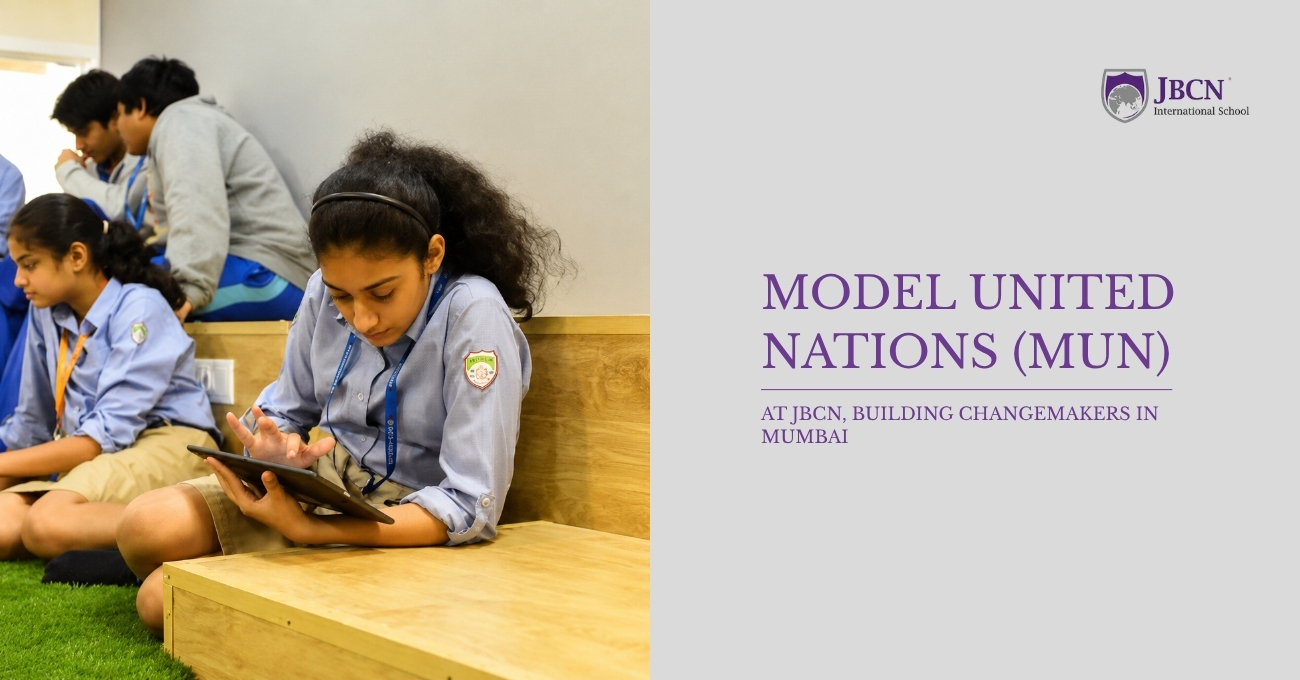
Parents often ask what turns a confident child into a genuinely persuasive one, and Model United Nations is one of the clearest answers a school can offer. A learner who once hesitated to raise a hand ends up representing a country in a simulated committee, defending a position, and negotiating a shared resolution. That shift, from quiet to composed under pressure, is exactly what MUN builds. Here is what Model United Nations involves, why it matters beyond the classroom, and how it lives inside JBCN's co-curricular programme in Mumbai.
What Is Model United Nations?
Model United Nations, or MUN, is a structured simulation of the United Nations where learners take on the role of delegates representing different countries. Each delegate researches their assigned nation, debates real global issues in committee, and works toward a written resolution. The format mirrors genuine diplomacy, with rules of procedure, formal speaking, and negotiation.
- Delegates represent an assigned country, not their own opinion.
- Committees debate real themes such as climate, security, or human rights.
- The goal is a drafted, negotiated resolution, not simply winning an argument.
Why MUN Matters for University Applications
MUN develops the exact capabilities universities look for: the ability to research deeply, argue clearly, and collaborate across disagreement. A delegate learns to hold a position under questioning and to find common ground, which reads far more convincingly on an application than a list of memberships. Skills like public speaking and confidence grow naturally through repeated committee sessions.
- Research and evidence-building on unfamiliar, complex topics.
- Structured argument and rebuttal under time pressure.
- Negotiation and consensus-building across opposing views.
How MUN Fits Into iPROPEL at JBCN
At JBCN, Model United Nations sits within iPROPEL, the school's skill-based co-curricular framework, as a Secondary-level component. iPROPEL spans innovation, performing arts, research and reasoning, outreach, physical fitness, experiential learning, and leadership, and MUN draws on the leadership and outreach strands directly. Placing MUN inside a structured programme means it is taught with intent, not left to chance.
Learners who take part connect the experience to the wider Changemaker goal JBCN sets, developing global awareness alongside academic depth. Real-world leadership also grows through related activities like CAS and clubs, which extend the same skills into service and community projects.
What a JBCN Learner Experiences in MUN
A learner in MUN moves through a clear arc, from preparation to debate to resolution, and each stage builds a distinct skill. The experience is demanding in the best sense, asking for both rigour and composure. Three parts stand out.
Committee Research and Position Papers
Before any debate, a delegate researches their country's stance and drafts a position paper. The stage teaches source evaluation, structured note-taking, and the discipline of arguing a view that may not be your own.
Debate, Negotiation, and Resolution Drafting
In committee, delegates speak formally, respond to challenges, and work in blocs to draft a resolution. Negotiation sits at the heart of it, since no resolution passes without persuading others to compromise.
Building Confidence Through Public Speaking
Repeated speaking in a formal setting steadily removes the fear of the floor. A learner who speaks in committee week after week carries that composure into presentations, interviews, and everyday classroom discussion.
JBCN Learner Achievements in MUN
JBCN Learners have earned recognition at MUN conferences across Mumbai and India, from external conferences to JBCN's own learner-led joint conference, JBCN MUN 2026, run under the theme "Diplomacy. Dialogue. Decisive Action." The awards below reflect skills built through sustained practice, from delegation and crisis committees to parliamentary debate. Each is a real example of what committee experience can lead to.
|
Learner |
Achievement and conference |
|
Niaan Dand |
High Commendation, DBIS MUN (Grade 9); High School Secretary-General, JBCN MUN 2026 |
|
Athiya Choudhari |
Indira Gandhi Best Female Parliamentarian Award, Sansad Youth Parliament 2025, New Delhi |
|
Asmita Valiani |
High Commendation, UNHRC (representing USA) |
|
Punya Galundia |
Special Mention, UNHRC (representing India) |
|
Sumedha Krishna |
Special Mention, UNHRC (representing India) |
|
Parth Bhawsar |
Delegation Award, UNSC (representing India) |
|
Adhish Chakravorty |
Delegation Award, UNSC (representing India) |
|
Devansh Bharatia |
Outstanding Delegate, ICC Oberoi International School MUN |
|
Priyansh Sata |
Outstanding Delegate, Continuous Crisis Committee (representing Iran) |
How to Prepare for Your First MUN Conference
A first conference feels less daunting with a simple preparation routine, and the habits transfer to every future session. Work through these steps in order.
- Research your assigned country's position on the committee topic thoroughly.
- Read the rules of procedure so the formal format feels familiar.
- Draft a short position paper summarising your stance and proposed solutions.
- Practise a one-minute opening speech aloud until it feels natural.
- Prepare to negotiate by anticipating where other countries will disagree.
Visit Our Campuses in Mumbai
The best way to see how MUN and iPROPEL shape a learner is to visit and watch a campus in motion. A short tour shows how diplomacy, research, and public speaking are woven into daily learning across JBCN's international schools in Mumbai.
Frequently Asked Questions
-
What Age Can Learners Start MUN?
At JBCN, Model United Nations is offered as a Secondary component of the iPROPEL programme, so learners typically begin from around Grade 8. Younger learners build the underlying skills of research and public speaking earlier through other iPROPEL activities. The formal MUN experience then builds on that foundation.
-
Do I Need Debate Experience to Join MUN?
No. Most first-time delegates arrive without any debate background, and MUN is designed to teach the format, research method, and speaking style from scratch. The learning curve is part of the point. Confidence grows session by session.
-
How Does MUN Help With IB or Cambridge Coursework?
MUN strengthens research, structured argument, and analysis, which carry directly into IB Theory of Knowledge, the IB Diploma Programme Extended Essay, and A Level essay writing. The habit of defending a position with evidence is exactly what these components reward. Many learners find their written work sharpens noticeably.
-
Does JBCN Run MUN as Part of Its Programme?
Yes. Model United Nations is a listed Secondary component of JBCN's iPROPEL co-curricular framework, so it is a genuine, scheduled part of school life rather than an occasional event. For the current calendar of conferences and clubs, contact your campus directly.
-
How Does MUN Help With University Applications?
MUN gives concrete evidence of leadership, communication, and global awareness, which admissions teams value across the UK, US, and beyond. More usefully, it supplies real examples a learner can write about in essays and speak to in interviews. Depth of involvement matters more than the number of conferences attended.
-
What Skills Does MUN Build?
Model United Nations builds research, public speaking, negotiation, diplomacy, and persuasive writing, along with the composure to defend a view under questioning. MUN skills are durable and transferable, serving a learner well beyond school. Confidence is often the most visible gain.
Share