
Published on: November 13, 2026
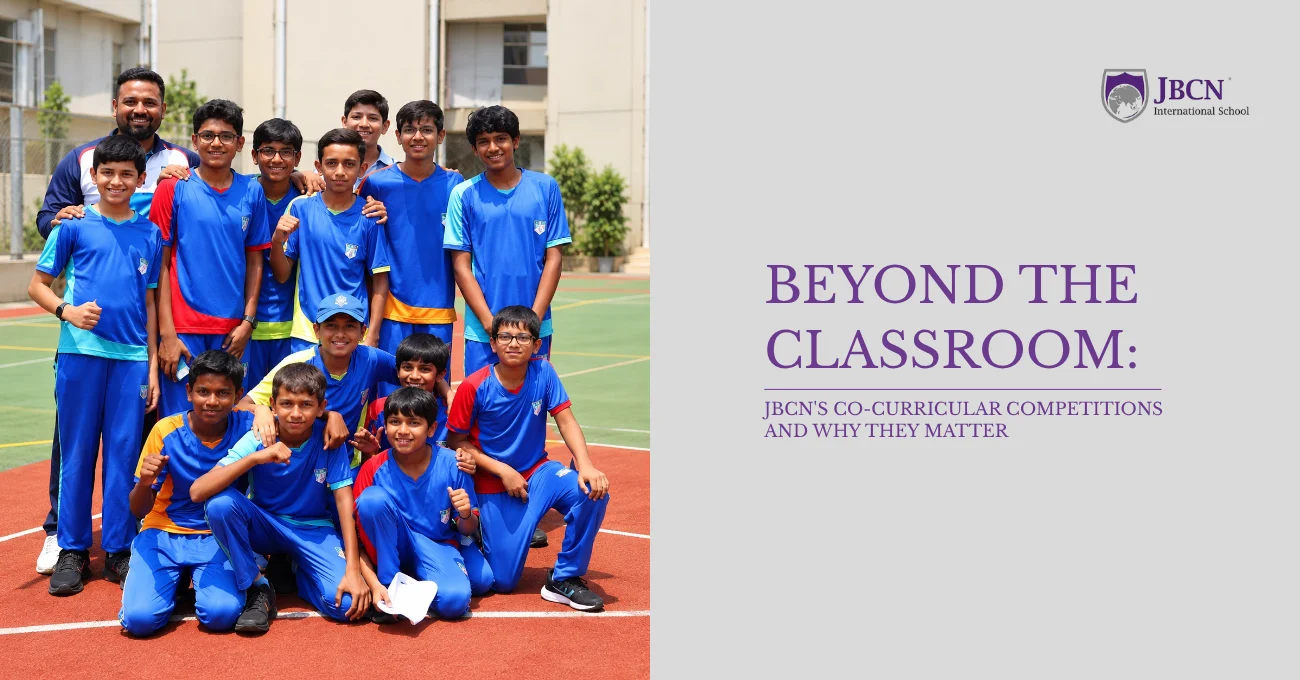
Many parents want to know what a school offers once the academic day ends. Will my child get real chances to compete, perform, and build confidence, or is it all lessons and homework? Competitions are where a child tests skills under pressure, learns to win and lose gracefully, and discovers strengths a report card never captures. JBCN organises these opportunities under a single framework called iPROPEL, so they are planned rather than occasional.
Why Competitive Co-Curriculars Matter for Skill Development
Competitive co-curriculars build skills that classroom lessons alone cannot, from public speaking to teamwork to composure under pressure. A child who prepares for a competition learns to research, rehearse, handle nerves, and recover from setbacks. Those habits carry into academics, university applications, and adult life.
The value is not the trophy but the growth behind it. A Learner who argues a position, performs on stage, or represents a team gains confidence that stays with them long after the event.
Public Speaking, Debate, and Model United Nations
Public speaking and debate sit at the heart of a child's confidence, and JBCN develops them through structured activities rather than one-off contests. Speech and Drama runs through the early and middle years, while Model United Nations gives senior Learners a serious platform for debate and diplomacy. Both teach a child to think on their feet and speak with conviction.
Speech and Drama in the Early Years
Speech and Drama helps younger Learners find their voice, build stage presence, and express ideas clearly. The activity nurtures the same skills that elocution and public speaking draw on later. Starting early makes confident speaking feel natural rather than daunting.
Model United Nations in the Senior Years
Model United Nations is a structured activity where Learners represent countries, debate real issues, and negotiate solutions. The experience builds research, argument, and public-speaking skills at a demanding level. MUN sits within JBCN's iPROPEL programme at the Secondary stage.
Academic and Innovation Competitions
Beyond speaking, JBCN gives Learners room to compete in thinking, coding, and creativity. The iPROPEL framework includes robotics, coding, and research and reasoning, which open the door to innovation-led challenges. Curiosity and problem-solving count for as much as memory here.
- Robotics and coding, introduced from the primary years onward.
- Research and reasoning, one of the iPROPEL focus areas.
- Creative writing and filmmaking at the senior stage.
- Innovation challenges that reward original problem-solving.
Performing Arts and Sports
Performing arts and sports give Learners a stage and a field to test themselves, and both run throughout JBCN's programme. Music, dance, and drama build expression and poise, while physical education and sports build fitness, discipline, and teamwork. Competition in these areas teaches resilience in a way few classroom tasks can.
Every child finds a different outlet, which is exactly the point of offering range. A Learner who struggles to shine in one arena often thrives in another, and the breadth lets them discover where they belong.
How iPROPEL Structures Opportunities by Age Group
iPROPEL is JBCN's co-curricular framework, built around seven focus areas and organised so activities suit a child's age and stage. The seven areas are innovation, performing arts, research and reasoning, outreach, physical fitness, experiential learning, and leadership. Each is introduced in an age-appropriate way as a child grows.
|
Stage |
Examples under iPROPEL |
|
Pre-Primary |
Speech and Drama, visual arts, music, dance, coding, robotics |
|
Primary |
Physical education, chess, music, Speech and Drama, robotics and coding |
|
Secondary |
Model United Nations, leadership and entrepreneurship, music, filmmaking, creative writing |
What Participation Looks Like
Participation at JBCN is built around preparation and mentorship, not just the event itself. Educators guide Learners through research, rehearsal, and feedback, so a child arrives ready and leaves having learned something. The journey matters as much as the result.
- Preparation: Learners research, rehearse, and refine with teacher guidance.
- Mentorship: educators and the iPROPEL programme support each child through the process.
- Outcomes: Learners build confidence, skills, and experiences that strengthen a university profile.
Take the Next Step
The best way to understand JBCN's co-curricular life is to see it in action on campus. If you want your child to grow beyond the classroom, the admissions team at your nearest JBCN campus can show you how iPROPEL works day to day. A campus visit brings the programme to life far better than any list.
Frequently Asked Questions
-
Can any Learner take part in competitions regardless of academic stream?
Yes, co-curricular opportunities at JBCN are open to Learners across stages and interests, not just a select few. The iPROPEL framework spans speaking, arts, sports, innovation, and leadership, so there is room for different strengths. Participation is encouraged as part of a well-rounded education.
-
What debate and public-speaking opportunities does JBCN offer?
JBCN develops debate and public speaking through Speech and Drama in the early years and Model United Nations at the Secondary stage. Both build research, argument, and confident speaking in a structured way, and both run within the iPROPEL co-curricular programme.
-
How are co-curricular activities chosen for younger Learners?
Activities for younger Learners are age-appropriate and introduced gradually under iPROPEL. The early years focus on Speech and Drama, music, dance, visual arts, coding, and robotics. The aim is to let young children explore widely before specialising later.
-
Do co-curricular competitions help with university applications?
Yes, sustained involvement in co-curricular activities strengthens a university application by showing initiative, commitment, and real skills. Universities value a Learner who has led, performed, or competed alongside strong academics. JBCN's counselling guides senior Learners on presenting these experiences well.
-
What is Model United Nations at JBCN?
Model United Nations is an activity where Learners represent countries, debate global issues, and negotiate solutions in a committee setting. A delegate builds research, public speaking, and diplomacy at a serious level. MUN runs within JBCN's iPROPEL programme at the Secondary stage.
-
Does JBCN offer sports and performing arts alongside academic competitions?
Yes, JBCN offers music, dance, drama, and sports alongside academic and innovation activities throughout its programme. Physical education and the arts run across the grade levels under iPROPEL. The breadth lets every child find an area where they can grow and compete.
Share