Published on: October 30, 2026
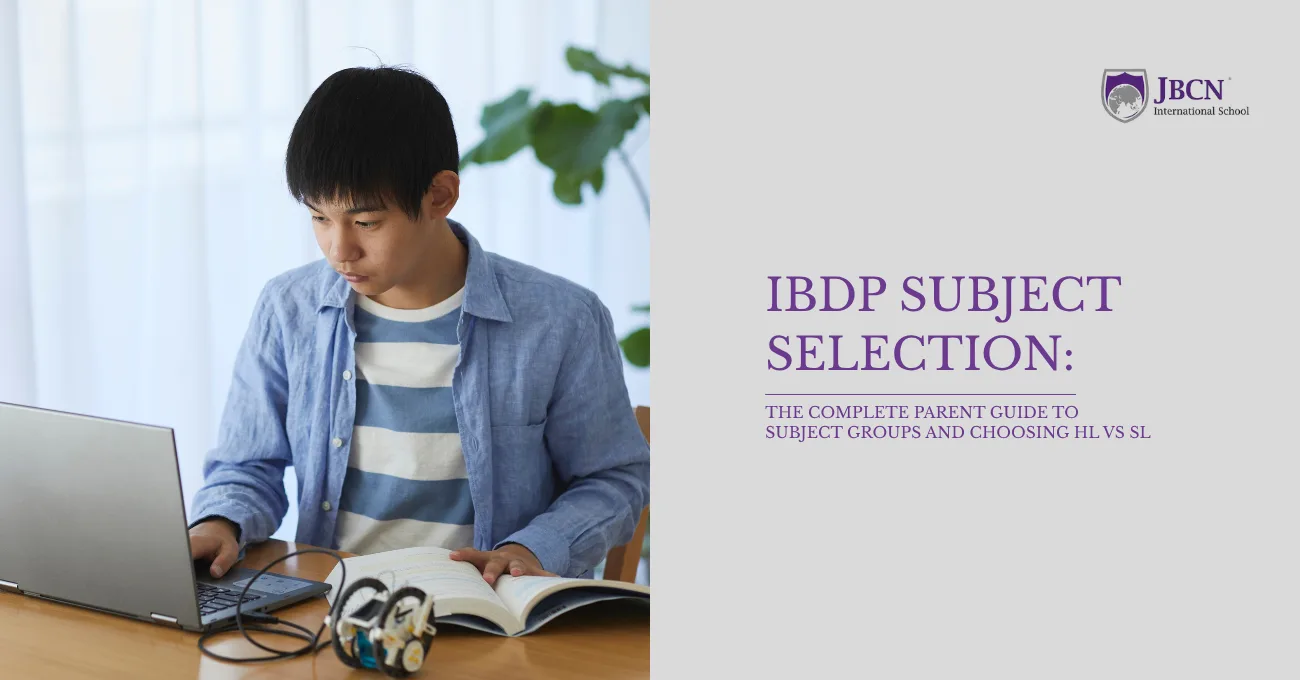
Choosing IBDP subjects is one of the first big decisions a family faces before Grade 11, and it can feel high-stakes. Which subjects should my child take, how do Higher and Standard Level differ, and will the choices keep their future options open? Subject selection in the IB Diploma means picking one subject from each of six groups, deciding Higher or Standard Level for each, and matching those choices to a child's goals. The guide below walks through the whole decision in plain terms.
The Six IB Subject Groups Explained
The IB Diploma is built around six subject groups, and a Learner usually chooses one subject from each. The groups make sure a child studies languages, humanities, sciences, mathematics, and the arts, giving the Diploma its signature breadth. Understanding the groups is the first step in planning a strong combination.
|
Group |
Area |
Examples |
|
1 |
Studies in Language and Literature |
English Language and Literature |
|
2 |
Language Acquisition |
Hindi B, French B, Spanish ab Initio |
|
3 |
Individuals and Societies |
Economics, Business Management, Psychology |
|
4 |
Sciences |
Physics, Chemistry, Biology, Computer Science |
|
5 |
Mathematics |
Mathematics AA, Mathematics AI |
|
6 |
The Arts |
Visual Arts |
A Learner may replace the Group 6 arts subject with a second subject from Groups 1 to 5, which allows combinations like two sciences. That flexibility is useful for a child aiming at a science-heavy degree.
How Many Subjects Do IB Diploma Learners Take
An IB Diploma Learner takes six subjects in total, three at Higher Level and three at Standard Level, alongside the core. The core adds Theory of Knowledge, the Extended Essay, and Creativity, Activity, Service, which run across the two years. Together these make up the full IB Diploma Programme.
The six subjects are each scored out of 7, and the core can add up to 3 more points, for a maximum of 45. The balance of three Higher and three Standard Level subjects is what a family plans carefully. Some Learners take four Higher Level subjects where their goals call for it.
HL vs SL and How to Decide
Higher Level and Standard Level differ in depth, teaching time, and how universities read them. A Higher Level subject is studied in greater depth over more hours, while a Standard Level subject covers the essentials. The key point is to take Higher Level in the subjects most central to a child's intended degree.
|
Factor |
Higher Level (HL) |
Standard Level (SL) |
|
Teaching time |
Around 240 hours |
Around 150 hours |
|
Depth |
Greater breadth and depth |
Core essentials |
|
University use |
Often required for a related degree |
Supports a balanced profile |
|
Diploma minimum |
Counts toward the HL points minimum |
Counts toward the SL points minimum |
A fuller treatment is available in the guide on how to choose HL and SL subjects. The sensible approach is to match Higher Level choices to the degree a child is leaning towards.
Choosing Between Mathematics AA and AI
Mathematics in the IB comes in two courses, and the choice between them is one of the most important a Learner makes. Mathematics Analysis and Approaches (AA) is more algebraic and calculus-focused, while Mathematics Applications and Interpretation (AI) is more statistical and applied. The right choice depends on the degree a child is aiming for, so it deserves careful thought.
|
Factor |
Mathematics AA |
Mathematics AI |
|
Focus |
Algebra, calculus, pure mathematics |
Statistics, modelling, real-world application |
|
Often suits |
Engineering, physics, computer science, mathematics |
Social sciences, design, business, some life sciences |
|
Engineering degrees |
Usually required or strongly preferred |
Often not accepted for competitive engineering |
|
Medicine |
Accepted at many medical schools |
Accepted at many medical schools |
|
JEE alignment |
Aligns well with JEE mathematics |
Less aligned with JEE's pure-maths focus |
Neither course is simply better than the other, and AI is widely accepted and valued for its statistical strength. Always confirm the exact maths requirement with each target university, since requirements vary. Guide on Mathematics AA versus AI explores this choice in more detail.
JBCN Parel's IBDP Subject Menu by Group
JBCN Parel offers a wide menu across all six IB subject groups, which lets Learners build combinations suited to a range of goals. The published menu covers languages, humanities, sciences, mathematics, and the arts. The current options by group are listed below.
- Group 1, Language and Literature: English Language and Literature.
- Group 2, Language Acquisition: Hindi B, French B, Spanish ab Initio, French ab Initio.
- Group 3, Individuals and Societies: Economics, Business Management, Psychology.
- Group 4, Sciences: Physics, Chemistry, Biology, Computer Science, Design Technology, Environmental Systems and Societies.
- Group 5, Mathematics: Mathematics AA, Mathematics AI.
- Group 6, the Arts: Visual Arts.
You can see the full list of subjects here.
Matching Subject Choices to University and Career Goals
The strongest subject combination is the one that matches a child's likely degree while keeping sensible options open. University courses often require specific Higher Level subjects, so planning backwards from the goal avoids closed doors. The pointers below show how common goals shape choices.
- Medicine: Chemistry HL is required by virtually every medical school, usually with Biology HL.
- Engineering: Physics HL with Mathematics AA is the standard combination for competitive courses.
- Economics or business: Economics or Business Management, often with Mathematics suited to the course.
- Computer science: Computer Science or Physics HL, typically paired with Mathematics AA.
- Humanities and law: strong Language and Literature with a relevant Group 3 subject.
Read guides on the best IB subjects for engineering and the best IB subjects for medicine.
When to Start Planning Subject Selection
Subject selection goes more smoothly when a family starts thinking about it well before Grade 11. Early planning lets a Learner keep the right options open and avoid last-minute pressure. The sequence below sets out a sensible timeline.
- Grade 9 and 10: notice a child's strengths and interests across subjects.
- Early Grade 10: explore possible university directions with school counsellors.
- Mid Grade 10: shortlist Higher Level subjects tied to likely degrees.
- Late Grade 10: confirm the Maths course and finalise the combination.
- Ahead of Grade 11: review choices with counsellors before locking them in.
Take the Next Step
Subject selection is far easier with a counsellor who knows both the IB and the universities your child is aiming for. If you want help mapping a combination, the admissions team can connect you with the guidance that supports this decision. A single planning conversation can save a family months of uncertainty.
Frequently Asked Questions
-
How Many Subjects Does an IB Diploma Learner Take?
An IB Diploma Learner takes six subjects, usually one from each of the six groups, with three at Higher Level and three at Standard Level. Alongside these sit the core components of Theory of Knowledge, the Extended Essay, and Creativity, Activity, Service. The six subjects and the core together make up the full Diploma.
-
What Are the Six IB Subject Groups?
The six groups are Studies in Language and Literature, Language Acquisition, Individuals and Societies, Sciences, Mathematics, and the Arts. A Learner usually chooses one subject from each group. The Group 6 arts subject can be swapped for a second subject from Groups 1 to 5.
-
Should My Child Choose Mathematics AA or AI?
Mathematics AA suits engineering, physics, computer science, and competitive mathematics, while Mathematics AI suits social sciences, design, and applied fields. Both are accepted at many medical schools, and AI is valued for its statistical strength. The right choice depends on the target degree, so confirm each university's requirements.
-
Can a Learner Change IB Subjects After Starting Grade 11?
Some changes are possible early in Grade 11, depending on timetabling and the school's advice. The best approach is to plan carefully before starting, since later changes become harder. JBCN's counsellors help Learners review combinations before they are finalised.
-
Do All IB Subject Combinations Keep STEM and Medicine Options Open?
No, STEM and medicine require specific Higher Level sciences and the right Mathematics course. Medicine usually needs Chemistry HL with Biology HL, and engineering needs Physics HL with Mathematics AA. Planning these choices early is how a family keeps those pathways open.
-
How Many Higher Level Subjects Does the IB Require?
A standard IB Diploma includes three Higher Level and three Standard Level subjects, though some Learners take four at Higher Level. Higher Level subjects are studied in greater depth and are often required for a related degree. Counsellors help match Higher Level choices to a child's goals.
-
What Subjects Can My Child Study in the IB at JBCN Parel?
JBCN Parel offers subjects across all six IB groups, including English Language and Literature, Economics, Business Management, Psychology, Physics, Chemistry, Biology, Computer Science, and more. Both Mathematics AA and AI are available, along with Visual Arts and several languages. The current menu is published on the campus IBDP page.
-
What Is the Minimum Needed to Pass the IB Diploma?
The IB Diploma is scored out of 45 and requires at least 24 points, along with conditions such as minimum totals of 12 points at Higher Level and 9 at Standard Level. A grade 1 in any subject means the Diploma is not awarded. Strong subject choices and school support make meeting these thresholds very achievable.
Share